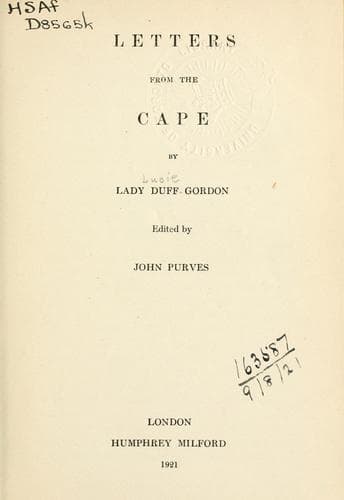
Cape of Good Hope (South Africa) -- Description and travel
It was into the little world of Caledon and Simonstown and Worcester,
drowsy, sun-steeped villages of the old colony—for Cape Town had little
attraction for her and the climate proved unsuitable—that this rare and
exquisite being descended. But the test of the true letter-writer, the
letter-writer of genius, is the skill and ease with which he brings
variety out of seeming monotony. The letters of Lady Duff Gordon answer
this test. She had not been many days in the country before she had
discovered (if she required to discover) the excellent principle: ‘Avoid
_engelsche hoogmoedigheid_ in dealing with the Dutch’; and by the time
she reaches Caledon she is on the best of terms with her new friends.
‘The postmaster, Heer Klein, and his old Pylades, Heer Ley, are great
cronies of mine’—she writes—‘stout old grey-beards, toddling down the
hill together. I sometimes go and sit on the stoep with the two old
bachelors and they take it as a great compliment; and Heer Klein gave me
my letters all decked with flowers, and wished “vrolyke tydings,
Mevrouw”, most heartily.’ She has a keen eye for the fine shades of
national character, and the modifications that spring from differences of
upbringing: the English farmer, ‘educated in Belgium’, the young Dutch
doctor with English manners, the German basket-maker’s wife in Cape Town.
A whole chapter might be written on her friendship with the Malays, whose
hearts she won as completely as she afterwards did those of their
Mohammedan brothers in Egypt. Mr. Ian Colvin has since opened up afresh
the field she was here almost the first to survey. In another direction,
in her remarks on the Eastern Province Jew of 1860, Lady Duff Gordon has
given us some notes which are of distinct value for social history. The
following passage, for example, deserves to be quoted as a ‘point de
repère’ in the evolution of a type. ‘These Colonial Jews’—says the
writer—‘are a new _Erscheinung_ to me. They have the features of their
race, but many of their peculiarities are gone. Mr. L—, who is very
handsome and gentlemanly, eats ham and patronises a good breed of pigs on
the “model farm” on which he spends his money. He is (he says) a
thorough Jew in faith, and evidently in charitable works; but he wants to
say his prayers in English and not to “dress himself up” in a veil and
phylacteries for the purpose; and he and his wife talk of England as
“home”, and care as much for Jerusalem as their neighbours. They have
not forgotten the old persecutions, and are civil to the coloured people,
and speak of them in quite a different tone from other English colonists.
Moreover, they are far better mannered and more ‘human’, in the German
sense of the word, in all respects; in short, less “colonial”.’ It was a
lady of this party who described Prince Albert’s funeral to Lady Duff
Gordon. ‘The people mourned for him’—she said—‘as much as for Hezekiah;
and, indeed, he deserved it a great deal better.’
Public-domain text, read in full here on John Shaqi.
Reviews
Reviews
No reviews yet
Be the first to share your thoughts on this work.
Join the Discussion
Join the discussion
Sign in to leave a comment or review.
Sign InorCreate an account