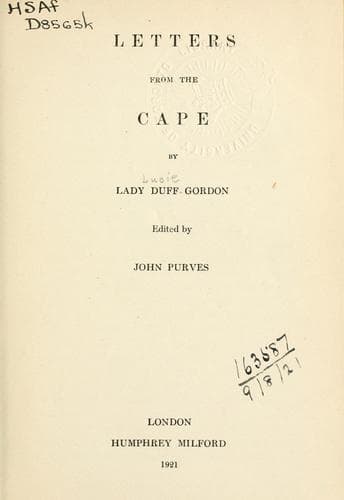
Cape of Good Hope (South Africa) -- Description and travel
There is not much attempt to describe scenery in Lady Duff Gordon’s
Letters, but just enough to show that her eye was as sensitive to
landscape as to the shades of racial character and feeling. She
indicates delicately yet effectively the difference between the
atmosphere at the coast and that inland. ‘It is the difference between a
pretty pompadour beauty and a Greek statue. Those pale opal mountains as
distinct in every detail as the map on your table and so cheerful and
serene; no melodramatic effects of clouds and gloom.’ But, as a rule, it
is the human pageant that engrosses her, and here her sense of values is
extraordinarily keen. There is no better instance than the portrait of
the German basket-maker’s wife, who confided to the writer her timidity
on landing in Africa. ‘I had never—she said—been out of the city of
Berlin and knew nothing.’ She spoke of the natives as well-bred
(_anständig_), and Lady Duff Gordon’s comment is: ‘The use of the word
was characteristic. She could recognize an _Anständigkeit_ not of
Berlin.’ But one might quote from every second page of these letters.
Lady Duff Gordon was less than a year in South Africa; but in that time
she brought more happiness to those around her than many have done in a
lifetime. And her bounties live after her.
A last remark may not be out of place here, although it will doubtless
occur to every reader who approaches these letters with sympathy and
discretion. They must be read as true letters and the spontaneous
delineation of a personality, and not as a considered contribution to
South African history. Freer even than Stevenson himself from ‘le
romantisme des poitrinaires’, and singularly clear-sighted in all that
comes under her personal observation, Lady Duff Gordon does not wholly
escape the nemesis which overtakes the traveller who accepts his history
from hearsay. And in South Africa, as we know, such nemesis is well-nigh
unfailing. Few, however, have been the travellers, as the following
pages will show, who could meet such a charge with so great evidence of
candour, disinterestedness, and love of human nature in its simplest and
most innocent forms.
J. P.
INTRODUCTORY
THE following letters were written, as the reader will readily perceive,
without the remotest view to publication. They convey in the most
unreserved manner the fresh and vivid impressions of the moment, to the
two persons with whom, of all others, the writer felt the least necessity
for reserve in the expression of her thoughts, or care about the form in
which those thoughts were conveyed.
Public-domain text, read in full here on John Shaqi.
Reviews
Reviews
No reviews yet
Be the first to share your thoughts on this work.
Join the Discussion
Join the discussion
Sign in to leave a comment or review.
Sign InorCreate an account