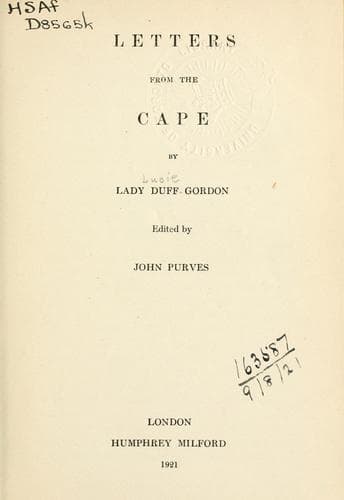
Cape of Good Hope (South Africa) -- Description and travel
I AM beginning now really to feel better: I think my cough is less, and I
eat a great deal more. They cook nice clean food here, and have some
good claret, which I have been extravagant enough to drink, much to my
advantage. The Cape wine is all so fiery. The climate is improving too.
The glorious African sun blazes and roasts one, and the cool fresh
breezes prevent one from feeling languid. I walk from six till eight or
nine, breakfast at ten, and dine at three; in the afternoon it is
generally practicable to saunter again, now the weather is warmer. I
sleep from twelve till two. On Christmas-eve it was so warm that I lay
in bed with the window wide open, and the stars blazing in. Such stars!
they are much brighter than our moon. The Dutchmen held high jinks in
the hall, and danced and made a great noise. On New Year’s-eve they will
have another ball, and I shall look in. Christmas-day was the hottest
day—indeed, the only _hot_ day we have had—and I could not make it out at
all, or fancy you all cold at home.
I wish you were here to see the curious ways and new aspect of
everything. This village, which, as I have said, is very like Rochefort,
but hardly so large, is the _chef lieu_ of a district the size of
one-third of England. A civil commander resides here, a sort of
_préfet_; and there is an embryo market-place, with a bell hanging in a
brick arch. When a waggon arrives with goods, it draws up there, they
ring the bell, everybody goes to see what is for sale, and the goods are
sold by auction. My host bought potatoes and brandy the other day, and
is looking out for ostrich feathers for me, out of the men’s hats.
The other day, while we sat at dinner, all the bells began to ring
furiously, and Capt. D— jumped up and shouted ‘_Brand_!’ (fire), rushed
off for a stout leather hat, and ran down the street. Out came all the
population, black, white, and brown, awfully excited, for it was blowing
a furious north-wester, right up the town, and the fire was at the
bottom; and as every house is thatched with a dry brown thatch, we might
all have to turn out and see the place in ashes in less than an hour.
Luckily, it was put out directly. It is supposed to have been set on
fire by a Hottentot girl, who has done the same thing once before, on
being scolded. There is no water but what runs down the streets in the
_sloot_, a paved channel, which brings the water from the mountain and
supplies the houses and gardens. A garden is impossible without
irrigation, of course, as it never rains; but with it, you may have
everything, all the year round. The people, however, are too careless to
grow fruit and vegetables.
Public-domain text, read in full here on John Shaqi.
Reviews
Reviews
No reviews yet
Be the first to share your thoughts on this work.
Join the Discussion
Join the discussion
Sign in to leave a comment or review.
Sign InorCreate an account