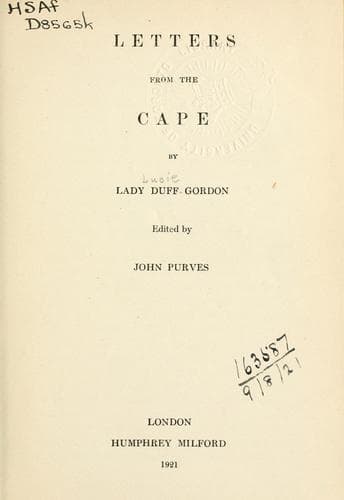
Cape of Good Hope (South Africa) -- Description and travel
How the cattle live is a standing marvel to me. The whole _veld_
(common), which extends all over the country (just dotted with a few
square miles of corn here and there), is covered with a low thin scrub,
about eighteen inches high, called _rhenoster-bosch_—looking like meagre
arbor vitæ or pale juniper. The cattle and sheep will not touch this nor
the juicy Hottentot fig; but under each little bush, I fancy, they crop a
few blades of grass, and on this they keep in very good condition. The
noble oxen, with their huge horns (nine or ten feet from tip to tip), are
never fed, though they work hard, nor are the sheep. The horses get a
little forage (oats, straw and all). I should like you to see eight or
ten of these swift wiry little horses harnessed to a waggon,—a mere flat
platform on wheels. In front stands a wild-looking Hottentot, all
patches and feathers, and drives them best pace, all ‘in hand’, using a
whip like a fishing-rod, with which he touches them, not savagely, but
with a skill which would make an old stage-coachman burst with envy to
behold. This morning, out on the veld, I watched the process of
breaking-in a couple of colts, who were harnessed, after many struggles,
second and fourth in a team of ten. In front stood a tiny foal cuddling
its mother, one of the leaders. When they started, the foal had its neck
through the bridle, and I hallooed in a fright; but the Hottentot only
laughed, and in a minute it had disengaged itself quite coolly and
capered alongside. The colts tried to plunge, but were whisked along,
and couldn’t, and then they stuck out all four feet and _skidded_ along a
bit; but the rhenoster bushes tripped them up (people drive regardless of
roads), and they shook their heads and trotted along quite subdued,
without a blow or a word, for the drivers never speak to the horses, only
to the oxen. Colts here get no other breaking, and therefore have no
paces or action to the eye, but their speed and endurance are wonderful.
There is no such thing as a cock-tail in the country, and the waggon
teams of wiry little thoroughbreds, half Arab, look very strange to our
eyes, going full tilt. There is a terrible murrain, called the
lung-sickness, among horses and oxen here, every four or five years, but
it never touches those that are stabled, however exposed to wet or wind
on the roads.
Public-domain text, read in full here on John Shaqi.
Reviews
Reviews
No reviews yet
Be the first to share your thoughts on this work.
Join the Discussion
Join the discussion
Sign in to leave a comment or review.
Sign InorCreate an account