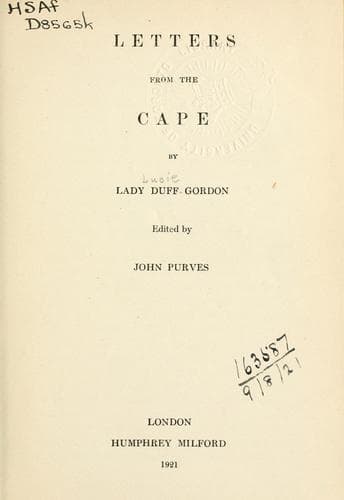
Cape of Good Hope (South Africa) -- Description and travel
An old ‘bastaard’ woman, married to the Malay tailor here, explained to
me my popularity with the coloured people, as set forth by ‘dat Malay
boy’, my driver. He told them he was sure I was a ‘very great Missis’,
because of my ‘plenty good behaviour’; that I spoke to him just as to a
white gentleman, and did not ‘laugh and talk nonsense talk’. ‘Never say
“Here, you black fellow”, dat Misses.’ The English, when they mean to be
good-natured, are generally offensively familiar, and ‘talk nonsense
talk’, i.e. imitate the Dutch English of the Malays and blacks; the
latter feel it the greatest compliment to be treated _au sérieux_, and
spoken to in good English. Choslullah’s theory was that I must be
related to the Queen, in consequence of my not ‘knowing bad behaviour’.
The Malays, who are intelligent and proud, of course feel the annoyance
of vulgar familiarity more than the blacks, who are rather awe-struck by
civility, though they like and admire it.
Mrs. D— tells me that the coloured servant-girls, with all their faults,
are immaculately honest in these parts; and, indeed, as every door and
window is always left open, even when every soul is out, and nothing
locked up, there must be no thieves. Captain D— told me he had been in
remote Dutch farmhouses, where rouleaux of gold were ranged under the
thatch on the top of the low wall, the doors being always left open; and
everywhere the Dutch boers keep their money by them, in coin.
_Jan._ 3_d._—We have had tremendous festivities here—a ball on New
Year’s-eve, and another on the 1st of January—and the shooting for Prince
Alfred’s rifle yesterday. The difficulty of music for the ball was
solved by the arrival of two Malay bricklayers to build the new
parsonage, and I heard with my own ears the proof of what I had been told
as to their extraordinary musical gifts. When I went into the hall, a
Dutchman was _screeching_ a concertina hideously. Presently in walked a
yellow Malay, with a blue cotton handkerchief on his head, and a
half-bred of negro blood (very dark brown), with a red handkerchief, and
holding a rough tambourine. The handsome yellow man took the concertina
which seemed so discordant, and the touch of his dainty fingers
transformed it to harmony. He played dances with a precision and feeling
quite unequalled, except by Strauss’s band, and a variety which seemed
endless. I asked him if he could read music, at which he laughed
heartily, and said, music came into the ears, not the eyes. He had
picked it all up from the bands in Capetown, or elsewhere.
Public-domain text, read in full here on John Shaqi.
Reviews
Reviews
No reviews yet
Be the first to share your thoughts on this work.
Join the Discussion
Join the discussion
Sign in to leave a comment or review.
Sign InorCreate an account