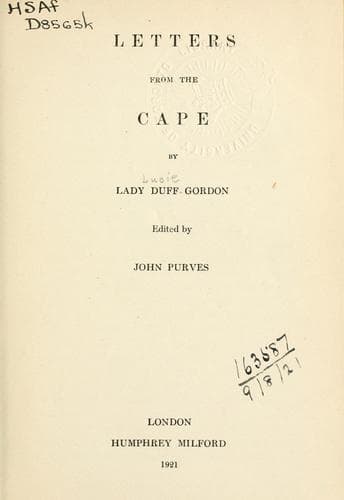
Cape of Good Hope (South Africa) -- Description and travel
A poor little, very old Bosjesman crept up, and was jeered and bullied.
I scolded the lad who abused him for being rude to an old man, whereupon
the poor little old creature squatted on the ground close by (for which
he would have been kicked but for me), took off his ragged hat, and sat
staring and nodding his small grey woolly head at me, and jabbering some
little soliloquy very _sotto voce_. There was something shocking in the
timidity with which he took the plate of food I gave him, and in the way
in which he ate it, with the _wrong_ side of his little yellow hand, like
a monkey. A black, who had helped to fetch the hamper, suggested to me
to give him wine instead of meat and bread, and make him drunk _for fun_
(the blacks and Hottentots copy the white man’s manners _to them_, when
they get hold of a Bosjesman to practise upon); but upon this a handsome
West Indian black, who had been cooking pies, fired up, and told him he
was a ‘nasty black rascal, and a Dutchman to boot’, to insult a lady and
an old man at once. If you could see the difference between one negro
and another, you would be quite convinced that education (i.e.
circumstances) makes the race. It was hardly conceivable that the
hideous, dirty, bandy-legged, ragged creature, who looked down on the
Bosjesman, and the well-made, smart fellow, with his fine eyes, jaunty
red cap, and snow-white shirt and trousers, alert as the best German
Kellner, were of the same blood; nothing but the colour was alike.
Then came a Dutchman, and asked for six penn’orth of ‘brood en kaas’, and
haggled for beer; and Englishmen, who bought chickens and champagne
without asking the price. One rich old boer got three lunches, and then
‘trekked’ (made off) without paying at all. Then came a Hottentot,
stupidly drunk, with a fiddle, and was beaten by a little red-haired
Scotchman, and his fiddle smashed. The Hottentot hit at his aggressor,
who then declared he _had been_ a policeman, and insisted on taking him
into custody and to the ‘Tronk’ (prison) on his own authority, but was in
turn sent flying by a gigantic Irishman, who ‘wouldn’t see the poor baste
abused’. The Irishman was a farmer; I never saw such a Hercules—and
beaming with fun and good nature. He was very civil, and answered my
questions, and talked like an intelligent man; but when Captain D— asked
him with an air of some anxiety, if he was coming to the hotel, he
replied, ‘No, sir, no; I wouldn’t be guilty of such a misdemeanour. I am
aware that I was a disgrace and opprobrium to your house, sir, last time
I was there, sir. No, sir, I shall sleep in my cart, and not come into
the presence of ladies.’ Hereupon he departed, and I was informed that
he had been drunk for seventeen days, _sans désemparer_, on his last
visit to Caledon. However, he kept quite sober on this occasion, and
amused himself by making the little blackies scramble for halfpence in
the pools left in the bed of the river. Among our customers was a very
Public-domain text, read in full here on John Shaqi.
Reviews
Reviews
No reviews yet
Be the first to share your thoughts on this work.
Join the Discussion
Join the discussion
Sign in to leave a comment or review.
Sign InorCreate an account