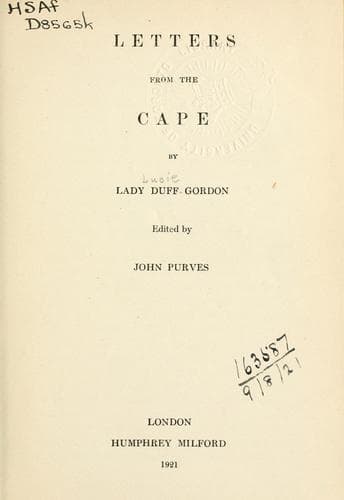
Cape of Good Hope (South Africa) -- Description and travel
I like this inn-life, because I see all the ‘neighbourhood’—farmers and
traders—whom I like far better than the _gentility_ of Capetown. I have
given letters to England to a ‘boer’, who is ‘going home’, i.e. to
Europe, the _first of his race since the revocation of the Edict of
Nantes_, when some poor refugees were inveigled hither by the Dutch
Governor, and oppressed worse than the Hottentots. M. de Villiers has
had no education _at all_, and has worked, and traded, and farmed,—but
the breed tells; he is a pure and thorough Frenchman, unable to speak a
word of French. When I went in to dinner, he rose and gave me a chair
with a bow which, with his appearance, made me ask, ‘_Monsieur vient
d’arriver_?’ This at once put him out and pleased him. He is very
unlike a Dutchman. If you think that any of the French will feel as I
felt to this far-distant brother of theirs, pray give him a few letters;
but remember that he can speak only English and Dutch, and a little
German. Here his name is _called_ ‘Filljee’, but I told him to drop that
barbarism in Europe; De Villiers ought to speak for itself. He says they
came from the neighbourhood of Bordeaux.
The postmaster, Heer Klein, and his old Pylades, Heer Ley, are great
cronies of mine—stout old greybeards, toddling down the hill together. I
sometimes go and sit on the stoep with the two old bachelors, and they
take it as a great compliment; and Heer Klein gave me my letters all
decked with flowers, and wished ‘Vrolyke tydings, Mevrouw,’ most
heartily. He has also made his tributary mail-cart Hottentots bring from
various higher mountain ranges the beautiful everlasting flowers, which
will make pretty wreaths for J—. When I went to his house to thank him,
I found a handsome Malay, with a basket of ‘Klipkaus’, a shell-fish much
esteemed here. Old Klein told me they were sent him by a Malay who was
born in his father’s house, a slave, and had been _his_ ‘_boy_’ and
play-fellow. Now, the slave is far richer than the old young master, and
no waggon comes without a little gift—oranges, fish, &c.—for ‘Wilhem’.
When Klein goes to Capetown, the old Malay seats him in a grand chair and
sits on a little wooden stool at his feet; Klein begs him, as ‘Huisheer’,
to sit properly; but, ‘Neen Wilhem, Ik zal niet; ik kan niet vergeten.’
‘Good boy!’ said old Klein; ‘good people the Malays.’ It is a relief,
after the horrors one has heard of Dutch cruelty, to see such an
‘idyllisches Verhältniss’. I have heard other instances of the same
fidelity from Malays, but they were utterly unappreciated, and only told
to prove the excellence of slavery, and ‘how well the rascals must have
been off’.
Public-domain text, read in full here on John Shaqi.
Reviews
Reviews
No reviews yet
Be the first to share your thoughts on this work.
Join the Discussion
Join the discussion
Sign in to leave a comment or review.
Sign InorCreate an account