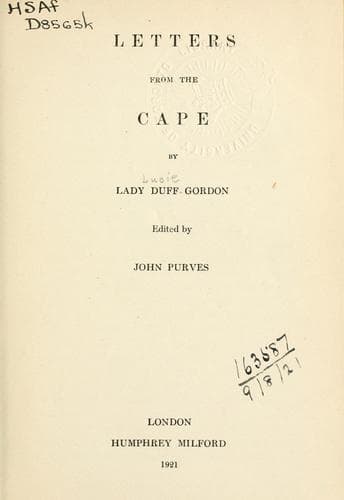
Cape of Good Hope (South Africa) -- Description and travel
Prayers lasted half an hour; then the congregation turned out of doors,
and the windows were opened. Some of the people went away, and others
waited for the ‘allgemeine Predigt’. In a quarter of an hour a much
larger congregation than the first assembled, the girls all with
net-handkerchiefs tied round their heads so as to look exactly like the
ancient Greek head-dress with a double fillet—the very prettiest and
neatest coiffure I ever saw. The gowns were made like those of English
girls of the same class, but far smarter, cleaner, and gayer in
colour—pink, and green, and yellow, and bright blue; several were all in
white, with white gloves. The men and women sit separate, and the
women’s side was a bed of tulips. The young fellows were very smart
indeed, with muslin or gauze, either white, pink, or blue, rolled round
their hats (that is universal here, on account of the sun). The
Hottentots, as they are called—that is, those of mixed Dutch and
Hottentot origin (correctly, ‘bastaards’)—have a sort of blackguard
elegance in their gait and figure which is peculiar to them; a mixture of
negro or Mozambique blood alters it altogether. The girls have the
elegance without the blackguard look; _all_ are slender, most are tall;
all graceful, all have good hands and feet; some few are handsome in the
face and many very interesting-looking. The complexion is a pale
olive-yellow, and the hair more or less woolly, face flat, and cheekbones
high, eyes small and bright. These are by far the most
intelligent—equal, indeed, to whites. A mixture of black blood often
gives real beauty, but takes off from the ‘air’, and generally from the
talent; but then the blacks are so pleasant, and the Hottentots are
taciturn and reserved. The old women of this breed are the grandest hags
I ever saw; they are clean and well dressed, and tie up their old faces
in white handkerchiefs like corpses,—faces like those of Andrea del
Sarto’s old women; they are splendid. Also, they are very clean people,
addicted to tubbing more than any others. The maid-of-all-work, who
lounges about your breakfast table in rags and dishevelled hair, has been
in the river before you were awake, or, if that was too far off, in a
tub. They are also far cleaner in their huts than any but the _very
best_ English poor.
Public-domain text, read in full here on John Shaqi.
Reviews
Reviews
No reviews yet
Be the first to share your thoughts on this work.
Join the Discussion
Join the discussion
Sign in to leave a comment or review.
Sign InorCreate an account