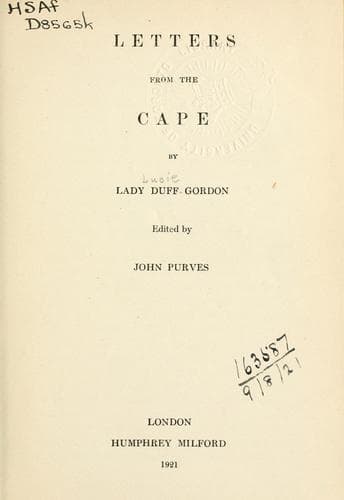
Cape of Good Hope (South Africa) -- Description and travel
The ‘Predigt’ was delivered, after more singing, by a missionary
cabinet-maker, in Dutch, very ranting, and not very wise; the
congregation was singularly decorous and attentive, but did not seem at
all excited or impressed—just like a well-bred West-end audience, only
rather more attentive. The service lasted three-quarters of an hour,
including a short prayer and two hymns. The people came out and filed
off in total silence, and very quickly, the tall graceful girls draping
their gay silk shawls beautifully. There are seven missionaries, all in
orders but one, the blacksmith, and all married, except the resident
director of the boys’ boarding-school; there is a doctor, a carpenter, a
cabinet-maker, a shoe-maker, and a storekeeper—a very agreeable man, who
had been missionary in Greenland and Labrador, and interpreter to
MacClure. There is one ‘Studirter Theolog’. All are Germans, and so are
their wives. My friend the storekeeper married without having ever
beheld his wife before they met at the altar, and came on board ship at
once with her. He said it was as good a way of marrying as any other,
and that they were happy together. She was lying in, so I did not see
her. At eight years old, their children are all sent home to Germany to
be educated, and they seldom see them again. On each side of the church
are schools, and next to them the missionaries’ houses on one side of the
square, and on the other a row of workshops, where the Hottentots are
taught all manner of trades. I have got a couple of knives, made at
Gnadenthal, for the children. The girls occupy the school in the
morning, and the boys in the afternoon; half a day is found quite enough
of lessons in this climate. The infant school was of both sexes, but a
different set morning and afternoon. The missionaries’ children were in
the infant school; and behind the little blonde German ‘Mädels’ three jet
black niggerlings rolled over each other like pointer-pups, and grinned,
and didn’t care a straw for the spelling; while the dingy yellow little
bastaards were straining their black eyes out, with eagerness to answer
the master’s questions. He and the mistress were both Bastaards, and he
seemed an excellent teacher. The girls were learning writing from a
master, and Bible history from a mistress, also people of colour; and the
stupid set (mostly black) were having spelling hammered into their thick
skulls by another yellow mistress, in another room. At the boarding
school were twenty lads, from thirteen up to twenty, in training for
school-teachers at different stations. Gnadenthal supplies the Church of
England with them, as well as their own stations. There were Caffres,
Fingoes, a Mantatee, one boy evidently of some Oriental blood, with
glossy, smooth hair and a copper skin—and the rest Bastaards of various
hues, some mixed with black, probably Mozambique. The Caffre lads were
splendid young Hercules’. They had just printed the first book in the
Public-domain text, read in full here on John Shaqi.
Reviews
Reviews
No reviews yet
Be the first to share your thoughts on this work.
Join the Discussion
Join the discussion
Sign in to leave a comment or review.
Sign InorCreate an account