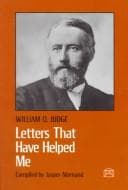
Judge, William Quan, 1851-1896; Theosophists -- United States -- Correspondence; Theosophy
If we take, with all due reverence, so much of the standpoint of the
Supreme as our finite minds or our dawning intuition may permit, we
feel that he stands above unmoved by either Good or Evil. Our good
is relative, and evil is only the limitation of the soul by matter.
From the material essence of the Deity all the myriad differentiations
of Nature (Prakriti, cosmic substance), all the worlds and their
correlations are evolved. They assist the cyclic experience of the
soul as it passes from state to state. How, then, shall we say
that any state is evil in an absolute sense? Take murder. It seems
an evil. True, we cannot _really_ take life, but we can destroy a
vehicle of the divine Principle of Life and impede the course of a
soul using that vehicle. But we are more injured by the deed than any
other. It is the fruit of a certain unhealthy state of the soul. The
deed sends us to hell, as it were, for one or more incarnations; to
a condition of misery. The shock, the natural retribution, our own
resultant Karma, both the penalties imposed by man and that exacted by
occult law, chasten and soften the soul. It is passed through a most
solemn experience which had become necessary to its growth and which
in the end is the cause of its additional purification. In view of
this result, was the deed evil? It was a necessary consequence of the
limitations of matter; for had the soul remained celestial and in free
Being, it could not have committed murder. Nor has the immortal soul,
the spectator, any share in the wrong; it is only the personality, the
elementary part of the soul, which has sinned. All that keeps the soul
confined to material existence is evil, and so we cannot discriminate
either. The only ultimate good is Unity, and in reality nothing but
that exists. Hence our judgments are in time only. Nor have we the
right to exact a life for a life. "Vengeance is mine, saith the Lord
(Law); I will repay." We become abetters of murder in making such human
laws. I do not say that every experience must be gone through bodily,
because some are lived out in the mind. Nor do I seek to justify any.
The only justification is in the Law.
The innocent man unjustly murdered is rewarded by Karma in a future
life. Indeed, any man murdered is reimbursed, so to say; for while that
misfortune sprang from his Karma, occult law does not admit of the
taking of life. Some men are the weapons of Karma in their wrong-doing,
but they themselves have appointed this place to themselves in their
past.
Public-domain text, read in full here on John Shaqi.
Reviews
Reviews
No reviews yet
Be the first to share your thoughts on this work.
Join the Discussion
Join the discussion
Sign in to leave a comment or review.
Sign InorCreate an account