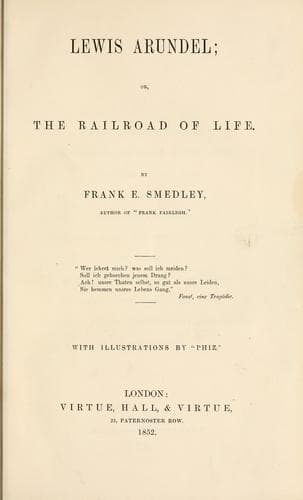
Lewis Arundel; Or, The Railroad Of LifeSmedley, Frank E. (Frank Edward)
General
Lewis Arundel; Or, The Railroad Of Life
Smedley, Frank E. (Frank Edward)
English fiction -- 19th century
“Silence and solitude,” he continued, opening the door of a large
drawing-room handsomely furnished. “I hope they won’t be long before
they introduce us to the luncheon-table. Oysters are popularly supposed
to give one an appetite; but the natives we demolished at Frere’s last
night must have been sadly degenerate, for I declare to you I could
scarcely get through my breakfast this morning. Ah! what have we
here?--a water-colour landscape in a semi-chaotic condition. Annie has
been sketching, as sure as fate. I’ll introduce a few masterly touches
and surprise her.” So saying he seated himself at the table and began
dabbling with a brush.
“By Jove, I’ve done it now!” he exclaimed in a tone of consternation,
after a minute’s pause. “Just look here; I thought I would insert the
trunk of a tree in the foreground, and the confounded brush had got red
in it, so I have made a thing like a lobster and spoiled the drawing.”
“I think, if you wish, I could turn it into a cow, and so get you out
of the scrape,” suggested Lewis, smiling at his companion’s guilty
countenance.
“My dear fellow, the very thing,” exclaimed Leicester, hastily rising
and thrusting Lewis into his seat; “let’s have a cow, by all means.
That’s famous,” he continued, as with a few graphic strokes Lewis
converted the red daub into the semblance of an animal. “Bravo! make her
an eye--now the horns--what a fascinating quadruped! Where’s the tail to
come?”
“You would not see the tail in the position in which the cow is supposed
to be lying,” remonstrated Lewis.
“Still, it would make it more natural,” urged Leicester. “As a personal
favour, just to oblige me, stretch a point and give her a tail.”
“There, then, I’ve twisted it under her leg,” said Lewis, making the
desired addition; “but depend upon it, there never was a cow’s tail so
situated.”
“All the greater proof of your talent,” was the reply. “The ideal is
what you artists (for I see you are one) are always raving about, and
this is a specimen of it.”
So engrossed had the two young men been with their occupation that they
had not observed the entrance of a third person. The newcomer was that
most charming of all created beings, a very lovely girl of seventeen.
Public-domain text, read in full here on John Shaqi.
Reviews
Reviews
No reviews yet
Be the first to share your thoughts on this work.
Join the Discussion
Join the discussion
Sign in to leave a comment or review.
Sign InorCreate an account