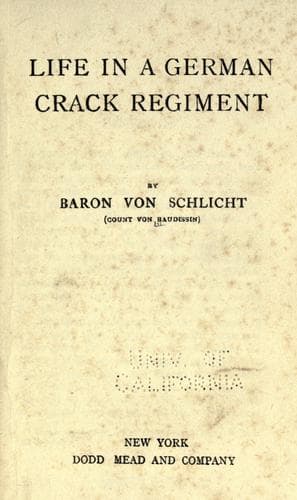
Life in a German Crack RegimentBaudissin, Wolf Ernst Hugo Emil, Graf von
General
Life in a German Crack Regiment
Baudissin, Wolf Ernst Hugo Emil, Graf von
Germany. Heer -- Military life -- Fiction; Soldiers -- Fiction
Not that suitors were lacking; one after another had endeavoured to
win her favour, but each in turn drew back when he heard of her lack
of dowry. None of the officers of the Guards--and neither Frau von
Warnow nor Hildegarde would have looked at anyone else--was rich
enough to marry a girl whose marriage portion consisted of her beauty
and a whole family plunged in debt. For it was not only the father's
debts that a son-in-law would have to pay, but a brother's, for the
latter was known as a giddy spendthrift and gambler. Hildegarde's
father could not in the least understand why after her first winter
in Berlin she returned home without a _fiancé_. He had so absolutely
reckoned upon a wealthy son-in-law that the non-realisation of his
hopes seemed to him like a terrible blow dealt him by Fate, and it
was long before he recovered from it. But at last hope had sprung up
once again in his heart, although there was really no prospect of
anything for either him or his daughter. Hildegarde's brother also
looked to her for deliverance; it surely must come one day, and he
was so deeply in debt that he could only just keep his head above
water by opportunely winning something at cards; but that could not
go on for long. His rich relatives helped him now and again with £50
or so, but he never dreamed of using this for paying his debts, but
usually gambled it away directly he got it. Whenever he was in a hole
he would write to his sister: "Fulfil the hopes that are centred upon
you; save us all, and do not be so haughty in your demands. It is
true that the idea of a middle-class brother-in-law, who has probably
never worn dress clothes and has moved in a quite different social
circle, is abhorrent to me, still I'd put up with him if only he had
money and was willing to help us."
Hildegarde scarcely ever read these letters nowadays, for she know
beforehand what they contained. Her father was in the habit of saying
exactly the same things when a bill came to the house, or her mother
asked for money for housekeeping, or the servants demanded their
wages. He always said on such occasions:
"Put away your aristocratic pride until you have got a husband.
There are any number of rich middle-class men who would be only
too delighted to get for their miserable money a beautiful and
aristocratic wife who would introduce them into Society and give them
a good social position. When you have got your husband then you can
be as aristocratic as ever you like, in order to impress him, and the
more you show what a sacrifice you made when you accepted him, the
more he will love and honour you."
Public-domain text, read in full here on John Shaqi.
Reviews
Reviews
No reviews yet
Be the first to share your thoughts on this work.
Join the Discussion
Join the discussion
Sign in to leave a comment or review.
Sign InorCreate an account