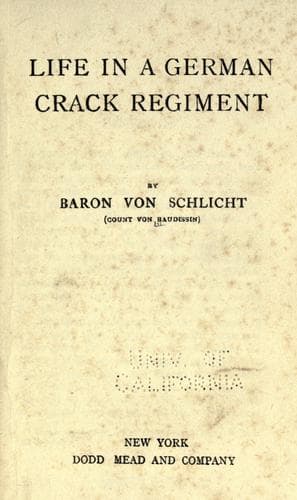
Life in a German Crack RegimentBaudissin, Wolf Ernst Hugo Emil, Graf von
General
Life in a German Crack Regiment
Baudissin, Wolf Ernst Hugo Emil, Graf von
Germany. Heer -- Military life -- Fiction; Soldiers -- Fiction
Hildegarde could scarcely restrain herself from crying out: "What
am I to do? I can hardly do anything more than allow myself to be
exhibited and admired. I can't very well actually offer myself to
the men. I am often so terribly ashamed that I scarcely know how to
endure such a life, and what you say seems horrible to me. I cannot
understand how you can talk to me in this way; you ought to have
more respect for your daughter than to do so. It's money, money,
everlasting money; and to pay your debts I am to sell myself to the
first best man who offers sufficient for my body."
On such occasions violent speeches were on the tip of her tongue,
but she always restrained herself, for she knew what a terrible
struggle her father had, and how he lay awake for hours racking his
brains how to make both ends meet. When he had first left the army
he had delayed trying to get an appointment, for then he considered
it beneath his dignity to become the agent of an insurance company
or something of the sort; now it was too late, and he was not young
enough to get work. To the end of his life he was condemned to lead
this miserable existence of an officer who had been pensioned early:
there was neither career nor money for him. His wife suffered almost
more than he did; she was an elegant, distinguished-looking woman,
who longed to be back in Berlin and to share in the magnificent
entertainments where she had been so much admired. A violent dispute
had taken place between her and her husband when he retired to the
provincial town; she would deny herself, she would put up with all
kinds of deprivations, but she longed to breathe again the air she
had formerly enjoyed. "Only wait a year or so until Hildegarde is
married, and then we will go back again to Berlin," her husband had
said to her again and again. And at last she had given in. At first
she had firmly resolved to live very economically in the little town,
but by degrees she was again the distinguished and elegant woman of
society who could not alter her mode of living and her _toilettes_.
She spoke to her daughter continually of her prospective marriage,
and there were hours when she did not scruple to reproach her child
violently: "How is it that other young girls, who are not nearly so
beautiful and elegant as you, get married? You must be either very
stand-offish or you must make it too apparent that you want to get
married. Both attitudes are unsuitable."
Public-domain text, read in full here on John Shaqi.
Reviews
Reviews
No reviews yet
Be the first to share your thoughts on this work.
Join the Discussion
Join the discussion
Sign in to leave a comment or review.
Sign InorCreate an account