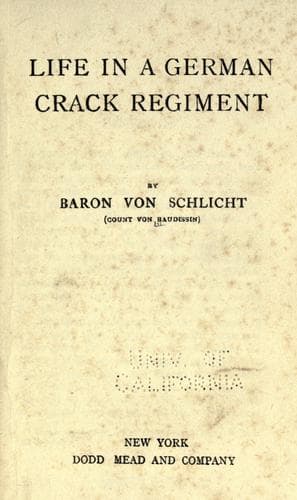
Life in a German Crack RegimentBaudissin, Wolf Ernst Hugo Emil, Graf von
General
Life in a German Crack Regiment
Baudissin, Wolf Ernst Hugo Emil, Graf von
Germany. Heer -- Military life -- Fiction; Soldiers -- Fiction
Hildegarde suffered terribly from the speeches and all the family
circumstances, but she suffered even more on account of the visits to
her relatives. It is true it was a pleasure to be in a rich household
once again, to hear nothing of money worries; but letters from her
parents followed her to Berlin with the request that she should
borrow money for them from their relatives. Then again the gaieties
were quite spoiled for her, because every evening before going to bed
her aunt used to say, "Has nothing of importance happened to-day?"
And even if her aunt did not actually say this, and tried not to let
her see what she felt, Hildegarde noticed that it was no longer a
pleasure to her aunt to take her about, for she saw the uselessness
of all her efforts, and would have preferred her niece not to have
visited her again.
This year Hildegarde had determined not to go to Berlin; her pride
and her vanity revolted against being a burden to her relatives
again, and playing a despicable, yet pitiable, _rôle_. She had often
noticed both the contemptuous and the sympathetic glances with which
she had been greeted when she paid calls; some people privately
joked at the idea of her not having given up thinking about a
husband, others, knowing her straitened circumstances, felt sympathy
for her.
"Under no circumstances will I go to Berlin this year," she
declared to her parents. "I am too proud and too ashamed to exhibit
myself again at all the parties, and yet get neither a lover nor a
purchaser!"
The dispute lasted all day long, but at last her father, who was
threatened with a warrant for distraint on account of a wine bill
for five hundred marks, fell on his knees before her and begged her
to save him. Then at last her opposition gave way. But she felt so
wretched and miserable, so degraded and despondent, that during the
long railway journey she constantly wept.
"My dear child, you have never before looked so out of sorts; what
is the matter with you?" her aunt had asked her, and she had only
been reassured when Hildegarde feigned a violent headache. Her
aunt breathed more freely, but next morning and the following days
Hildegarde's looks did not satisfy her, and it was impossible to
conceal the fact that she was no longer the blooming young girl that
she had been. Her aunt looked at her sympathetically, and more to
herself than to her niece she said, "It's high time--high time!"
"Yes, it certainly is," chimed in Hildegarde, "for I cannot bear
this life any longer. If I do not get engaged this time--and I am
convinced I shall _not_--I am going to get a place as a governess or
a companion, or something of the sort. This I know--I won't go home
again."
Public-domain text, read in full here on John Shaqi.
Reviews
Reviews
No reviews yet
Be the first to share your thoughts on this work.
Join the Discussion
Join the discussion
Sign in to leave a comment or review.
Sign InorCreate an account