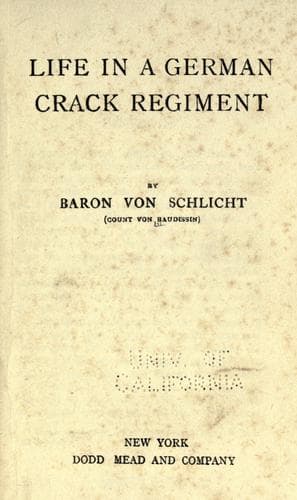
Life in a German Crack RegimentBaudissin, Wolf Ernst Hugo Emil, Graf von
General
Life in a German Crack Regiment
Baudissin, Wolf Ernst Hugo Emil, Graf von
Germany. Heer -- Military life -- Fiction; Soldiers -- Fiction
George remained completely isolated among his companions. Nobody
troubled in the least about him. His astonishment therefore was all
the greater when one day after lunch his adjutant sat down beside
him, and engaged him in a long and very friendly conversation. He
could not quite account for this mark of distinction, but he quickly
understood when Count Wettborn suddenly said to him: "I have for
a long time meant to ask you why your father does not try to get
a title. The thing is certainly not easy, but your father is well
thought of by His Majesty, and it would be easy to overcome the
difficulty if your father would be disposed to give a couple of
hundred thousand marks for some charitable object. Your father could
certainly do that--why doesn't he?"
"Because my father is proud of his own name, which he has made an
honourable one."
The count rubbed his feet with some embarrassment, then he said: "Of
course, your father is quite right as far as he himself is concerned,
but he ought to think of you. You would take quite a different
position in Society if you were a baron or a count. The world lays
great stress on this, and in my opinion it is quite right. For you,
especially, now that you belong to a distinguished regiment, a title
would be of the greatest value."
The count talked to George for a long time, and the latter saw
clearly that the adjutant in saying all he did was not following
a sudden impulse, but was acting on mature reflection, and had
evidently consulted the wish of the colonel or one or other of the
military authorities. George felt the blood mount to his cheeks. He
felt ashamed that his companion had the audacity to talk to him in
this way. Good heavens! was a title then, which could be bought for
a few hundred thousands, really of much more importance to these
aristocratic lieutenants, who were ciphers when they got out of
their uniforms, than a good, old, simple middle-class name which was
honoured and respected by the whole commercial world?
He could not help saying in reply to the adjutant: "My father has
often enough been offered a peerage, but every time he has refused
it."
"I cannot understand such a thing." The count stuck his eyeglass in
more firmly and looked at George with speechless astonishment. "I
really cannot understand it," he repeated, and George saw that he
spoke in bitter earnest. He really _could_ not understand how a man
could refuse a title, simply because he was proud of his own plain
name.
For a long while the adjutant sat silent, then he finished the
conversation with the remark: "Well, perhaps you will write to your
father again about this matter, or, better still, perhaps you will
talk to him. You may be able to change his mind."
Public-domain text, read in full here on John Shaqi.
Reviews
Reviews
No reviews yet
Be the first to share your thoughts on this work.
Join the Discussion
Join the discussion
Sign in to leave a comment or review.
Sign InorCreate an account