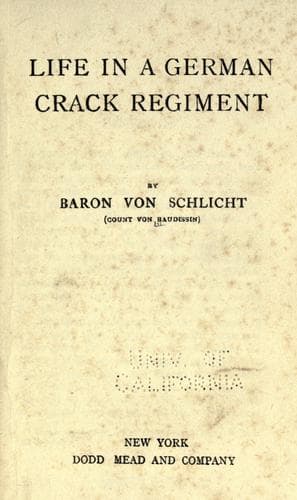
Life in a German Crack RegimentBaudissin, Wolf Ernst Hugo Emil, Graf von
General
Life in a German Crack Regiment
Baudissin, Wolf Ernst Hugo Emil, Graf von
Germany. Heer -- Military life -- Fiction; Soldiers -- Fiction
George did not answer, but he knew how his father always laughed at
the people who directly they had made money had no other ambition in
life but to get a title. He felt that the words which the adjutant
had just addressed to him were almost an insult, and yet when he
considered them quietly, he could not altogether take umbrage at
them. He saw every day of his life how the aristocracy had the
preference in everything; how even in these enlightened days a title
possessed many advantages, and that it was given to men of wealth as
a distinction and an honour. And even in the army was not a title
of advantage to a man? If three officers, one of whom had a title,
went in for a post, was not the aristocrat always chosen, and if by
the rarest chance a middle-class man was ever successful in such a
case, was he not at once ennobled? The position of an officer is
only suited for a man with a title. The old adage was very suitable
for present days--the plebeian in the army who did not distinguish
himself in some extremely remarkable manner would never get promotion
as soon as the most ordinary commonplace titled officer.
And was it any different in Society? George had now been to quite
enough social entertainments to know how everyone bowed down to a
title; how even the youngest aristocratic lieutenant was considered
superior to a staff-officer of plebeian birth. And how often had he
not noticed how people hummed and hawed at the sight of him, and
could not understand how it was he belonged to such a distinguished
regiment. Although the words had been softly spoken he had once heard
a young girl at a ball whisper to a friend: "If Lieutenant Winkler
asks me to dance, I shall say my programme is full; I shall certainly
not dance with a middle-class officer."
All the women regarded him as an outsider. A bare nod was their only
greeting, even the one or two who shook hands with him did this
without breaking off their conversation, and with an expression
which showed they thought they were doing him a great favour. But he
was just as much isolated in the army as in Society; his comrades
chattered and laughed with the ladies, had all kinds of little
intrigues with them, made engagements with them, while he wandered
about alone and bored. He was an "outsider," and nobody troubled to
introduce him.
Public-domain text, read in full here on John Shaqi.
Reviews
Reviews
No reviews yet
Be the first to share your thoughts on this work.
Join the Discussion
Join the discussion
Sign in to leave a comment or review.
Sign InorCreate an account