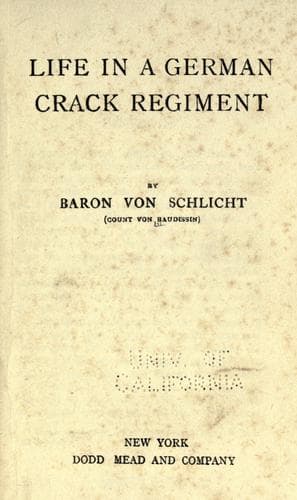
Life in a German Crack RegimentBaudissin, Wolf Ernst Hugo Emil, Graf von
General
Life in a German Crack Regiment
Baudissin, Wolf Ernst Hugo Emil, Graf von
Germany. Heer -- Military life -- Fiction; Soldiers -- Fiction
"I beg your pardon, I do not say that, but they ought to marry whom
they like, only not lieutenants, who, in nine hundred and ninety-nine
cases out of one thousand would not dream of marrying if they were
not up to their ears in debt."
"It is all very well for you to talk," said the other. "It is easy
you know for a man who is born into the world a millionaire to judge
a poor devil severely. What you say is all very beautiful and noble
in theory, but what about practice? When I can, I prefer to ride in
my own carriage, rather than the electric tram. Ah, here our ways
separate, you go to the right, I to the left. What time do you go on
duty to-morrow?"
"Not at all in the morning."
"Lucky fellow, I must be on parade at seven. Good-night."
After a cool handshake the comrades separated and a little later
George reached his rooms.
CHAPTER VI
MILITARY MORALS
IT had all turned out just as George had foretold; the kindly
words which His Majesty had addressed to him at the American
Embassy and the warm praise of his father, had not contributed
towards improving his position in the regiment; on the contrary,
it had made it worse. Scarcely a day passed but some one or other
in George's absence talked about him and discussed the Emperor's
remarks. Whatever had made the Emperor specially distinguish him,
the only plebeian officer of the regiment? Even the colonel had had
to be content with a mere handshake, the staff officers, not to
mention the others, had scarcely received a glance; George alone
had been addressed. Was it mere chance or was it really the report
of the button manufacturer--as Old Winkler was always called for
shortness--that had occasioned the remarks? And what on earth could
such a manufacturer tell His Majesty which he did not know already?
Old Winkler indeed was said to be unique in his arrangements for
the benefits of his workpeople and in his efforts for their welfare,
and he had discovered new methods and means of ameliorating their
existence. Of course, everybody knew that His Majesty was deeply
interested in the condition of the working classes, but in spite
of this, they thought this public praise of Old Winkler somewhat
ostentatious and superfluous, if an officer--and therefore a loyal
subject--might venture to criticise His Majesty's words. Or had the
Emperor's words any particular significance? The Emperor knew, of
course, what was thought about George in the regiment, how he was
still an "outsider," and would always remain one. Had His Majesty's
words meant--"You need not trouble yourselves, you will not get rid
of Lieutenant Winkler, he has a powerful protector in me." Had he
perhaps wanted to encourage George by his gracious words to persevere
and not to despair even if he had not succeeded in winning a good
position in the regiment?
Public-domain text, read in full here on John Shaqi.
Reviews
Reviews
No reviews yet
Be the first to share your thoughts on this work.
Join the Discussion
Join the discussion
Sign in to leave a comment or review.
Sign InorCreate an account