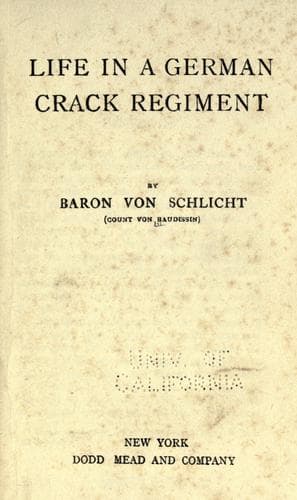
Life in a German Crack RegimentBaudissin, Wolf Ernst Hugo Emil, Graf von
General
Life in a German Crack Regiment
Baudissin, Wolf Ernst Hugo Emil, Graf von
Germany. Heer -- Military life -- Fiction; Soldiers -- Fiction
Not a single "Golden Butterfly" had ever been commanded to attend
at Court, except on the occasion of some great entertainment; then
the regiment had appeared as a whole, and even this distinction had
made them feel very proud. And now George was publicly invited by the
Emperor to come with his father to dine at Court. It was well known
that His Majesty frequently gave little parties where everybody was
quite unconstrained, and there was much lively conversation. The
Emperor surprised everyone by the astonishing amount of his knowledge
and fascinated all by his great personal attractions. Why should
George be invited to share in these intimate little parties? Simply
because he was the son of his father. And who indeed was his father?
He was merely a middle-class button manufacturer, and he would remain
that, even if he were wiser and more important than all the other
wise men put together.
They would not have grudged any of their other companions the honour
which had been paid to George. They would have regarded it as an
honour paid to the aristocratic classes to which they themselves
belonged. They grudged it George because they said to themselves:
"If nowadays the middle-class is to be honoured in this way, what is
there then for the nobility, who have done, and will do more, for
Germany than manufacture trouser-buttons, which certainly have the
advantage of being durable and cheap."
Up till the present the officers had not troubled to take any notice
of George. Now they turned their attention to him, and although he
was always quiet and modest in his behaviour to his companions, and
yet dignified without being proud, they became even haughtier than
they had formerly been. More than ever they were the aristocrats;
more than ever they endeavoured to show him what a great and
impassable barrier divided him from them. Their behaviour indicated
as clearly as words: "We intend to get rid of him; one day he himself
will perceive that he cannot possibly remain with us any longer."
George was perfectly well aware of the feeling that existed against
him, and even if he had wanted to deceive himself in this matter,
one thing would have opened his eyes to this fact. This was the
condescending manner in which young Willberg regularly every week,
purely as a matter of form, made his excuses for not having been able
to return the £50 which he had been obliging enough to lend him.
"I really do not want the money," George said every time; "on the
contrary, I live so economically that I save money. I would gladly
lend you a larger amount, and you need not hurry about paying it
back."
Public-domain text, read in full here on John Shaqi.
Reviews
Reviews
No reviews yet
Be the first to share your thoughts on this work.
Join the Discussion
Join the discussion
Sign in to leave a comment or review.
Sign InorCreate an account