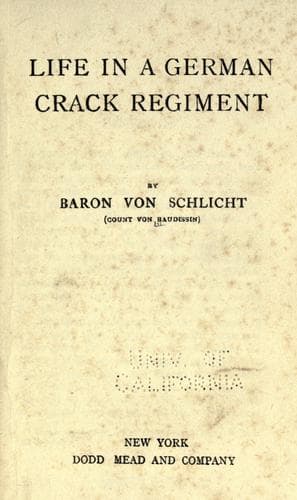
Life in a German Crack RegimentBaudissin, Wolf Ernst Hugo Emil, Graf von
General
Life in a German Crack Regiment
Baudissin, Wolf Ernst Hugo Emil, Graf von
Germany. Heer -- Military life -- Fiction; Soldiers -- Fiction
After a short pause the latter rose to thank them for the honour
they had done him, then he continued: "His Majesty has commanded
me to express his extreme regret that he cannot be present to-day
at the anniversary festival of the regiment; His Majesty has been
pleased to command me to offer to the regiment that has always
distinguished itself in war and peace his royal greeting, and to
assure the regiment of his imperial favour and his imperial good
wishes. His Majesty is quite sure that in the future, as in the past,
he may always depend upon the regiment, and he knows that each of you
is ready now as ever to sacrifice his life for his country and his
king, therefore His Majesty trusts that the spirit that has always
distinguished this regiment--the spirit of good fellowship--shall be
always fostered, and especially, here in these rooms."
The exalted personage paused, and a murmur of approval ran through
the assembled officers and guests who were standing up to listen to
the speech.
"Now the health of the regiment is going to be drunk," they all said,
and they looked to see whether their glasses were full, for it was
due to each man that in his own regiment his glass should be full.
But the expected conclusion of the speech was not immediately
forthcoming; the exalted personage was visibly embarrassed, and it
was apparent to everyone that he had still something to say, but
could not for the moment find the right words. At last he regained
his composure, and said: "Gentlemen, finally, His Majesty has
commanded me to inform you that to-day he has transferred to your
regiment Lieutenant Winkler, the son of His Majesty's commercial
adviser, who was formerly in the 25th Infantry Regiment. And now,
gentlemen," continued the Prince, in a louder tone, and visibly
relieved, "lift your glasses to the prosperity of this magnificent
regiment, whose officers unite in themselves the best names in the
land, and whose subalterns and rank and file present a shining
example of the most faithful fulfilment of duty--here's to the
regiment. Hurrah! hurrah! hurrah!"
They felt as if they had been throttled; such a sorrowful "hurrah"
had never before been heard, and it was a fortunate thing that the
loud-sounding fanfare echoed through the hall.
The "hurrahs" were over, His Highness had taken his seat again,
but the rest remained standing, staring at each other as if they
could not have heard aright, as if each wanted to learn from his
neighbour's face whether what he had just heard could really be the
fact.
"We have become a plebeian regiment."
Nobody knew who pronounced the word first, but at once the phrase
passed from lip to lip--"We have become plebeian."
It was just as if a jug of cold water had been thrown into their
faces, and indeed when at last they sat down to the table again
and the music struck up a merry _potpourri_, they could not grasp,
they could not take it in, this inevitable thing--that once more a
"commoner" was in the regiment.
Public-domain text, read in full here on John Shaqi.
Reviews
Reviews
No reviews yet
Be the first to share your thoughts on this work.
Join the Discussion
Join the discussion
Sign in to leave a comment or review.
Sign InorCreate an account