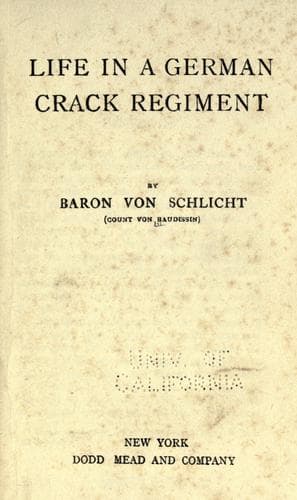
Life in a German Crack RegimentBaudissin, Wolf Ernst Hugo Emil, Graf von
General
Life in a German Crack Regiment
Baudissin, Wolf Ernst Hugo Emil, Graf von
Germany. Heer -- Military life -- Fiction; Soldiers -- Fiction
All their gay spirits had fled; indeed it appeared to the officers
of the "Golden Butterflies" as if a quite new spirit had taken
possession of the building. The festival had lost its splendour;
it seemed as if the silver itself suddenly shone less brilliantly,
as if the glass were less finely cut, and as if the hall no longer
possessed the unique elegance that had hitherto distinguished it.
A painful silence reigned at the table, the "Golden Butterflies"
did not venture to talk to their guests, for they knew they would
be besieged by questions as to who and what this Winkler really
was, where he came from, whatever could have caused His Majesty
to transfer him from his frontier garrison town to this proud and
distinguished regiment. It must have some signification. They did not
venture even to look at their guests, for they knew that in the faces
of the latter would stand clearly written: "You are no longer what
you were; you cannot indeed help it that you have become plebeian,
but the fact remains, and your position will be affected by this in
the future."
If only the news that they were to receive a plebeian lieutenant had
been communicated to them privately--but no, it had been announced
publicly, in the presence of all the assembled guests, so that there
was no possibility of denial or subterfuge. It was a direct slap in
the face for them, and for the former officers, some of whom had come
from a distance to be present at the dedication of the new buildings.
And now into that new house a new element had been introduced. A
commoner! Why had the regiment deserved it that the glory that had
hitherto distinguished it should be removed? On the former occasion
when a plebeian lieutenant had dwelt among them for a short time they
had all suffered, and it was esteemed a special mark of the Emperor's
favour that on the personally expressed wish of the officers he had
been transferred to a line regiment. When they were again relieved
of the stigma, each had sworn to live more zealously for the honour
of the regiment so that a plebeian should not for a second time be
received in their midst. Now this very thing had happened.
The Uhlan had regarded for a long time his neighbour who was looking
gloomily in front of him; now he felt impelled to utter a sympathetic
word, and everything that he felt in the depth of his heart he
put into the remark, "What a pity! you were all so jolly in your
regiment."
The officer of the "Golden Butterflies" shrugged his shoulders. What
did these words mean but this: "The beginning has been made, other
commoners will follow this one, and even if he does remain the only
one, you will never be again what you once were."
Public-domain text, read in full here on John Shaqi.
Reviews
Reviews
No reviews yet
Be the first to share your thoughts on this work.
Join the Discussion
Join the discussion
Sign in to leave a comment or review.
Sign InorCreate an account