Transcribed from the 1845 Thomas Nelson “Works of the Puritan Divines
(Bunyan)” edition by David Price, email ccx074@pglaf.org
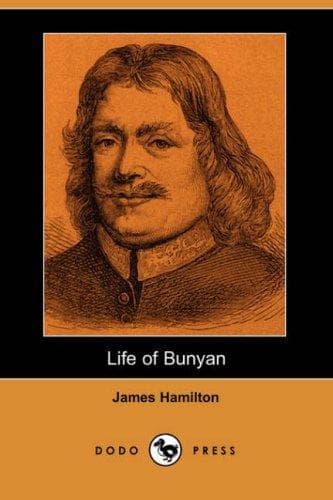
[Picture: Picture of John Bunyan]
LIFE OF BUNYAN
BY REV. JAMES HAMILTON
SCOTCH CHURCH, REGENT SQUARE, LONDON.
AFTER the pleasant sketches of pens so graceful as Southey’s and
Montgomery’s; after the elaborate biography of Mr Philip, whose
researches have left few desiderata for any subsequent devotee; indeed,
after Bunyan’s own graphic and characteristic narrative, the task on
which we are now entering is one which, as we would have courted it the
less, so we feel that we have peculiar facilities for performing it. Our
main object is to give a simple and coherent account of a most unusual
man—and then we should like to turn to some instructive purpose the
peculiarities of his singular history, and no less singular works.
* * * * *
John Bunyan was born at Elstow, near Bedford, in 1628. His father was a
brazier or tinker, and brought up his son as a craftsman of like
occupation. There is no evidence for the gipsy origin of the house of
Bunyan; and though extremely poor, John’s father gave his son such an
education as poor men could then obtain for their children. He was sent
to school and taught to read and write.
There has been some needless controversy regarding Bunyan’s early days.
Some have too readily taken for granted that he was in all respects a
reprobate; and others—the chief of whom is Dr Southey—have laboured to
shew that there was little in the lad which any would censure, save the
righteous overmuch. The truth is, that considering his rank of life, his
conduct was not flagitious; for he never was a drunkard, a libertine, or
a lover of sanguinary sports: and the profanity and sabbath-breaking and
heart-atheism which afterwards preyed on his awakened conscience, are
unhappily too frequent to make their perpetrator conspicuous. The thing
which gave Bunyan any notoriety in the days of his ungodliness, and which
made him afterwards appear to himself such a monster of iniquity, was the
energy which he put into all his doings. He had a zeal for idle play,
and an enthusiasm in mischief, which were the perverse manifestations of
a forceful character, and which may have well entitled him to Southey’s
epithet—“a blackguard.” The reader need not go far to see young Bunyan.
Perhaps there is near your dwelling an Elstow—a quiet hamlet of some
fifty houses sprinkled about in the picturesque confusion, and with the
easy amplitude of space, which gives an old English village its look of
leisure and longevity. And it is now verging to the close of the
summer’s day. The daws are taking short excursions from the steeple, and
tamer fowls have gone home from the darkening and dewy green. But old
Bunyan’s donkey is still browzing there, and yonder is old Bunyan’s
Public-domain text, read in full here on John Shaqi.
Reviews
Reviews
No reviews yet
Be the first to share your thoughts on this work.
Join the Discussion
Join the discussion
Sign in to leave a comment or review.
Sign InorCreate an account