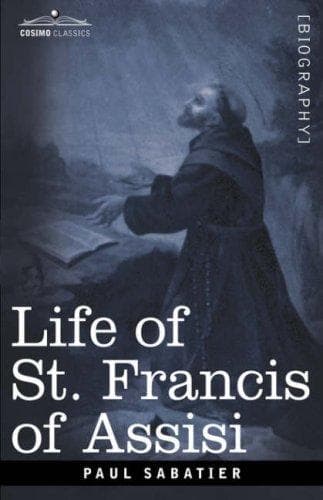
Christian saints -- Biography; Francis, of Assisi, Saint, 1182-1226
[21] The attempt of Durand of Huesca to create a mendicant order
has not yet been studied with sufficient minuteness. Chief of
the Waldenses of Aragon, he was present in 1207 at the
conference of Pamiers, and decided to return to the Church.
Received with kindness by the pope he at first had a great
success, and by 1209 had established communities in Aragon, at
Carcassonne, Narbonne, Beziers, Nimes, Uzes, Milan. We find in
this movement all the lineaments of the institute of St.
Dominic; it was an order of priests to whom theological studies
were recommended. They disappeared almost completely in the
storm of the Albigensian crusade. Innocent III., _epistolae_,
xi., 196, 197, 198; xii., 17, 66; xiii., 63, 77, 78, 94; xv.,
82, 83, 90, 91, 92, 93, 94, 96, 137, 146. The first of these
bulls contains the very curious Rule of this ephemeral order.
Upon its disappearance vide Ripoli, _Bullarium Praedicatorum_, 8
vols., folio, Rome, 1729-1740, t. i., p. 96. Cf. Elie Berger,
_Registres d'Innocent IV._, 2752.
[22] Burchard, of the order of the Premostrari, who died in
1226. See below, p. 234.
[23] 3 Soc., 52; Bon., 38.
[24] 3 Soc., 52 and 49.
[25] St. Antonino, Archbishop of Florence, saw very clearly that
it was _quaedam concessio simplex habitus et modi illius vivendi
et quasi permissio_. A. SS., p. 839. The expression "approbation
of the Rule" by which the act of Innocent III. is usually
designated is therefore erroneous.
* * * * *
CHAPTER VII
RIVO-TORTO
1210-1211
The Penitents of Assisi were overflowing with joy. After so many
mortally long days spent in that Rome, so different from the other
cities that they knew, exposed to the ill-disguised suspicions of the
prelates and the jeers of pontifical lackeys, the day of departure
seemed to them like a deliverance. At the thought of once more seeing
their beloved mountains they were seized by that homesickness of the
child for its native village which simple and kindly souls preserve till
their latest breath.
Immediately after the ceremony they prayed at the tomb of St. Peter, and
then crossing the whole city they quitted Rome by the Porta Salara.
Thomas of Celano, very brief as to all that concerns Francis's sojourn
in the Eternal City, recounts at full length the light-heartedness of
the little band on quitting it. Already it began to be transfigured in
their memory; pains, fatigues, fears, disquietude, hesitations were all
forgotten; they thought only of the fatherly assurances of the supreme
pontiff--the vicar of Christ, the lord and father of the Christian
universe--and promised themselves to make ever new efforts to follow the
Rule with fidelity.
Public-domain text, read in full here on John Shaqi.
Reviews
Reviews
No reviews yet
Be the first to share your thoughts on this work.
Elsewhere in the archive
Join the Discussion
Join the discussion
Sign in to leave a comment or review.
Sign InorCreate an account