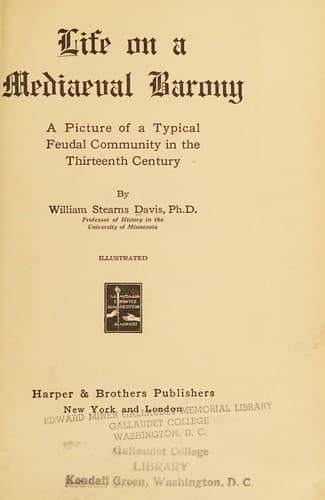
Life on a Mediaeval Barony: A Picture of a Typical Feudal Community in the Thirteenth CenturyDavis, William Stearns
History
Life on a Mediaeval Barony: A Picture of a Typical Feudal Community in the Thirteenth Century
Davis, William Stearns
Chivalry; Civilization, Medieval; Feudalism
The fundamental textbooks are Donatus's grammar for instruction in
Latin, and then for almost everything savoring of real learning, Latin
translations of Master Aristotle. For a long time the monks have had
to content themselves with the logical Works of the famous Grecian,
explaining the processes of argumentation, but by 1200 they can enjoy
the enormous advantage of using Latin versions of the Physics, the
Metaphysics, and the Ethics--the great works of The Master of Those
Who Know (to quote Dante, writing eighty years later). Some of these
books have come directly from the Greek, but others have been distorted
by passing through an Arabic version that in turn has been made over
into Latin. There are also various Arabic commentaries of considerable
value. Curious it doubtless is that Heaven, who has denied salvation
alike to Greek and to Moslem, should suffer unbelievers to possess a
worldly wisdom surpassing that of good Christians, but the Bible truly
says, "The children of this world are in their generation wiser than
the children of light." On all secular matters, indeed, Aristotle is
a final authority. "Thus says Aristotle" is the best way to silence
every hostile argument. Only very rarely can a man hope by his own
cogitations to overthrow the dicta of this wonderful sage of Athens.
A great deal of the monkish student's time is taken up with abstract
problems of philology and logic. Nevertheless, the abbey contains many
parchments widening to one's knowledge of the world. For example, you
can read in Vincent de Beauvais's _Mirror of Nature_ a minute account
of the universe and all things within it. You can learn the astonishing
fact that the world is a kind of globe suspended at the center of the
cosmos. Many other wonderful things are described--as, for example,
lead can be transmuted into gold, and all kinds of wonders which defy
ordinary experience, but which are not to be doubted, since God can,
of course, do anything. Or one can turn to Hugues de St. Victor's
treatise _On Beasts and Other Things_ and learn all about the habits of
animals--concerning how stags can live nine hundred years and how the
dove "with her right eye contemplates herself, and with her left eye
God." There are books also on medicine, parts of which contain sober
wisdom, worthy of attention by the murderous physicians, but elsewhere
giving such directions as that since autumn is "the melancholy season,"
people should then eat more heartily than in summer and should refrain
from love affairs.
Public-domain text, read in full here on John Shaqi.
Reviews
Reviews
No reviews yet
Be the first to share your thoughts on this work.
Elsewhere in the archive
Join the Discussion
Join the discussion
Sign in to leave a comment or review.
Sign InorCreate an account