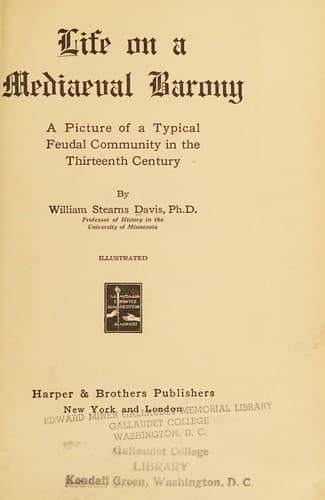
Life on a Mediaeval Barony: A Picture of a Typical Feudal Community in the Thirteenth Century — John Shaqi
Life on a Mediaeval Barony: A Picture of a Typical Feudal Community in the Thirteenth CenturyDavis, William Stearns
History
Life on a Mediaeval Barony: A Picture of a Typical Feudal Community in the Thirteenth Century
Davis, William Stearns
Chivalry; Civilization, Medieval; Feudalism
Having dressed and washed, the baron goes down to mass at the chapel.
Attending daily mass is a duty for every really pious seigneur. One
of Garnier's infamies had been his gross irregularity in this matter.
If there had been no chapel in the bailey, the service could have
been held in a vestibule to the hall of the _palais_. After mass
is over, Conon is ready for business or pleasures. It is a time of
peace; and, truth to tell, the baron would really be not a little
glad of the excitement, bustle, and strenuous preparation which come
with the outbreak of war. The list of things he can do to divert
himself in times of public quiet seems limited: He can hunt, fish,
fence, joust, play chess, eat and drink, listen to the songs of the
jongleurs, hold his court, walk in the meadows, talk with the ladies,
warm himself, have himself cupped and bled, and watch the snow fall.
This last amusement is hardly practicable in June. Being bled is not
commonly reckoned a regular sport in other ages! Neither can he hold
court--receive his vassals and dispense justice--save at intervals.
The jongleurs ordinarily reserve themselves for the evenings. Conon's
secret hankering for a war is, therefore, somewhat explicable.
If this is a fortunate day, however, the horn on the turret will blow,
and then the gong at the bailey gate will reverberate. A visitor of
noble rank has arrived. Nothing can ordinarily be more welcome in
castle communities. Little isolated fractions of humanity as they are,
with the remainder of the world seemingly at an extreme distance, the
coming of a stranger means a chance to hear news of the king's court,
of the doings of the Emperor Frederick II, of the chances of another
crusade, of the latest fashions in armor, of the newest methods of
training hawks, nay, possibly of rumors of another brave war like
that which culminated in the glorious battle of Bouvines. Unknightly,
indeed, is the seigneur who does not offer profuse hospitality to a
noble visitor; and any priest, monk, or law-abiding merchant will be
given a decent, though less ceremonious, welcome. No wonder the inns
everywhere are so bad, when the lords of so many castles grow actually
angry if a traveler will not tarry perhaps for days.
[Sidenote: Hospitality to Guests]
Public-domain text, read in full here on John Shaqi.
Reviews
Reviews
No reviews yet
Be the first to share your thoughts on this work.
Join the Discussion
Join the discussion
Sign in to leave a comment or review.
Sign InorCreate an account