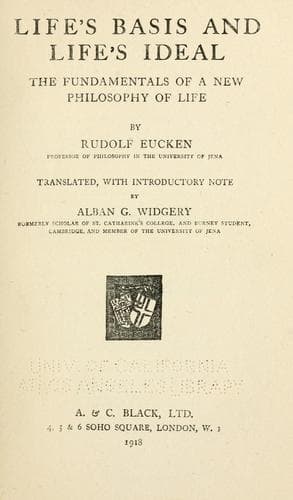
Life's Basis and Life's Ideal: The Fundamentals of a New Philosophy of LifeEucken, Rudolf
Philosophy
Life's Basis and Life's Ideal: The Fundamentals of a New Philosophy of Life
Eucken, Rudolf
Life; Ontology
Now, the impressions and experiences of modern life are opposed to
freedom in both of these senses; indeed, with apparently insuperable
force they oppose freedom in every sense. Modern science most clearly
shows that man belongs to a great world-whole and world-movement; his
life and work seem to be completely determined through his relations in
this whole; his whole life is subject to an irresistible destiny, and in
all his undertakings and conduct he can only follow the course directed
by it. This destiny assumes for us the most diverse forms; and through
this diversity surrounds us on all sides. Through the power of heredity
we enter life with a definite nature: in the family, the state, and the
society a particular kind of environment surrounds us and gives to our
nature its more detailed colouring: the age meets us with particular
tendencies, takes us up into itself with a supreme power, and just as
decidedly directs us towards certain ends as it diverts us from others.
Even in earlier times all this was not ignored, so far as the individual
aspects are concerned; but the Modern Age was the first to conceive the
problem as a whole, and with this it has pursued the idea of
determination even into the inner structure of the life of the soul,
with the demonstration that here also nothing is spontaneous, nothing
unmeditated, but that even down to the most primary impulse everything
depends upon something else, and proceeds from definite relations. From
this point of view the idea of freedom, and in particular that of a
freedom of choice, appears to be only a remnant of an unscientific way
of thinking. The fact that man feels--as an immediate impression--free
in cases of hesitation between different possibilities has lost its
power to convince the individual of the Modern Age. For the new mode of
thought has evolved point for point along with an increasing divergence
from the naïve manner of representation, and it has won its greatest
victories in opposition to this manner of representation. The revolution
that Copernicus accomplished in the representation of the world has
become typical of the whole of modern work; and as regards our problem
also, dissent from ordinary opinion is less a cause for doubt than a
recommendation.
Public-domain text, read in full here on John Shaqi.
Reviews
Reviews
No reviews yet
Be the first to share your thoughts on this work.
Elsewhere in the archive
Join the Discussion
Join the discussion
Sign in to leave a comment or review.
Sign InorCreate an account