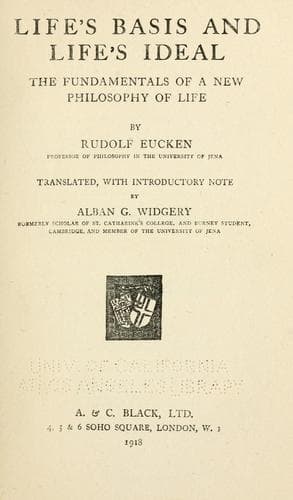
Life's Basis and Life's Ideal: The Fundamentals of a New Philosophy of LifeEucken, Rudolf
Philosophy
Life's Basis and Life's Ideal: The Fundamentals of a New Philosophy of Life
Eucken, Rudolf
Life; Ontology
In reality the case is entirely different. The stream of the ages
becomes spiritually significant to us only in so far as we develop an
independence of it. The stream does not itself, automatically and
independently of us, select the elements of value which it contains or
unite the ages to a harmonious result: we ourselves must achieve this.
Spiritually regarded, we do not from the beginning stand upon a sure
foundation, on which we might peacefully build; we must first acquire
such a foundation through endeavour, and in this matter we see doubt and
violent change continually make that uncertain which is apparently most
secure, and make it necessary to seek greater depths.
For this treatment of history, involving, as it does, self-determining
activity, an elevation above time is essential. Without in some way
transcending time we could not survey individual events and unite them
in one representation. But we would do far more than that; we would
select and take up into our own life that which is valuable in the
earlier, in order thereby to enrich and strengthen our life, and to lead
it as far as possible from the present of the mere moment to a present
encompassing the ages. How could this come to pass unless we were able
to secure an independent vantage ground transcending the stream of the
ages; a vantage ground from which we may survey and judge the ages,
appropriate some elements from them and reject others? Experience shows
clearly enough that the tendency and the content of life with which we
meet the past, decide what shall be its spiritual representation, and
how we shall stand in relation to it. For experience shows that each
main tendency of life has its own view of history and its own treatment
of history; it shows further that every change in life which is in any
way far-reaching involves an alteration in our relation to the past;
gives prominence to the new, and relegates the old to the background.
There arises therefore a history of history; a history, for example, of
that which in the life of Antiquity has seemed essential and valuable to
the different later ages. For us, therefore, history, in regard to its
spiritual nature, is involved in constant change. The past does not
decide concerning the present so much as the present concerning the
past; the past is not something dead and fixed behind us; ever anew it
becomes the object of passionate conflict.
Public-domain text, read in full here on John Shaqi.
Reviews
Reviews
No reviews yet
Be the first to share your thoughts on this work.
Elsewhere in the archive
Join the Discussion
Join the discussion
Sign in to leave a comment or review.
Sign InorCreate an account