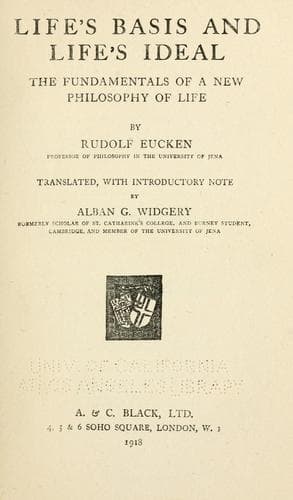
Life's Basis and Life's Ideal: The Fundamentals of a New Philosophy of LifeEucken, Rudolf
Philosophy
Life's Basis and Life's Ideal: The Fundamentals of a New Philosophy of Life
Eucken, Rudolf
Life; Ontology
But does not this dependence of the past upon the present deprive
history of all independence and of all value? Does it not surrender life
completely to the contingency of the changing moments? Does it not
destroy all inner unity of the ages? This would, in fact, be the case
if the matter remained on a simply human basis; if a spiritual life
transcending time were not manifested through all the changes of the
ages; if a spiritual history could not be distinguished from a narrowly
human one. Spiritual history is concerned with that which through all
human activity and endeavour reveals a self-conscious inner life and
which, as such a revelation, is valid not only for a particular age but
through all ages and independently of all ages. Spiritual history would
be impossible unless there is active within us from the beginning an
independent spiritual life which first realises its content through the
historical process.
Such a transcendent nature is most evident at those highest points of
human development which we call "classical," not because they should
dominate and bind all ages, but because in them the spiritual life
attained to a complete independence over against man, lifted him above
himself into the fire and flood of creative activity, and made it
possible for him to produce characteristic contents. These classical
achievements are especially important for the development of life if
they not only bring something new in individual departments and in
particular directions, but also shape and present the whole to us in a
distinctive manner, and seek to appropriate to themselves, and in the
appropriation to elevate, the spiritual impulse that exists in man; if a
new being, in contrast to nature and society, emerges and would become
lord of the whole. Life as a whole is thus transformed into a problem
and a conflict. The question is whether this movement is able to take up
everything into itself and to lead life to its highest level, or whether
it meets with an insuperable resistance. In this matter life tests
itself by itself, by its own development--a thing which is possible only
if its experiences arise out of its being as a whole. If in a particular
case it proves that essential requirements remain unsatisfied, that the
movement is not able to include the spiritual life within itself, a
severe convulsion is inevitable, the spiritual life as a whole comes to
a standstill, and there can be no advance until life concentrates anew
and the new concentration gains ground. It is to be expected that a new
concentration will bring forward and develop that, in particular, which
formerly did not find complete satisfaction. In the first place,
therefore, there is an abrupt break and the emergence of an apparently
irreconcilable opposition: the old is relegated to the background;
tested by the new, the old soon comes to be regarded as a complete
mistake. In reality it is not so. For, as certainly as spontaneous
Public-domain text, read in full here on John Shaqi.
Reviews
Reviews
No reviews yet
Be the first to share your thoughts on this work.
Elsewhere in the archive
Join the Discussion
Join the discussion
Sign in to leave a comment or review.
Sign InorCreate an account