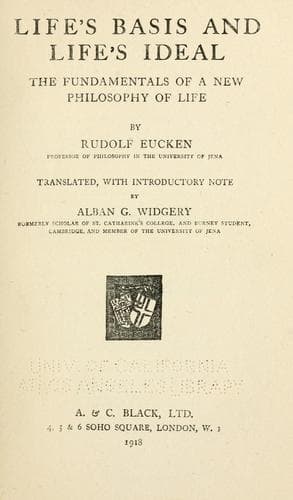
Life's Basis and Life's Ideal: The Fundamentals of a New Philosophy of LifeEucken, Rudolf
Philosophy
Life's Basis and Life's Ideal: The Fundamentals of a New Philosophy of Life
Eucken, Rudolf
Life; Ontology
If there are powerful hindrances to this endeavour for something more
than the subjective, there is at the same time a wealth of movement
which bids defiance to them, and the course of history shows continuous
expansion and development of this movement; it shows that man is able to
take up a conflict against the trivially human, and, in the building up
of a new world, to raise himself essentially above his original
condition. Exact science breaks away from the object of perception,
removes it to a distance, analyses it there, ascertains its laws, and
then restores it in changed form to men: in this it also advances human
life in itself, in that thought rises more freely above perception, and
a system of pure thought sustains the whole world of sense. A further
divergence between the struggle for physical existence and the building
up of a new world appears in history in the endeavour for happiness and
a significant content of life. In the experience of humanity, morality
and religion, looked at inwardly, assume two fundamentally different
forms. On the one hand they are looked upon as a mere means to support
man in a given world; to bring him into congenial relation with the
world; and so to organise this world that it may achieve as much as
possible for human well-being. This form governs human experience at its
general level, and easily comes to be regarded as the only form. At
higher levels of creative activity, however, a totally different form
made its appearance: there was a break with the whole world of sense and
well-being as though with something intolerably narrow, and in a
self-conscious life a new world arose and brought forth characteristic
contents; the appropriation of this world raised life above all mere
particularity and subjectivity; at the same time this appropriation
became an infinite task and work for man and for humanity as a whole. If
this form of religion and morality has been manifested with complete
clearness only at high levels of life in history, from these heights
this form has also exerted an influence upon the rest of life, animating
and raising it; indeed, it is only this genuine conception of religion
and morality which first gives to them an independence and a value in
themselves. Thus, notwithstanding the inadequacy of human achievement we
cannot but recognise that life transcends mere subjectivity and the
separation that it involves.
Public-domain text, read in full here on John Shaqi.
Reviews
Reviews
No reviews yet
Be the first to share your thoughts on this work.
Elsewhere in the archive
Join the Discussion
Join the discussion
Sign in to leave a comment or review.
Sign InorCreate an account