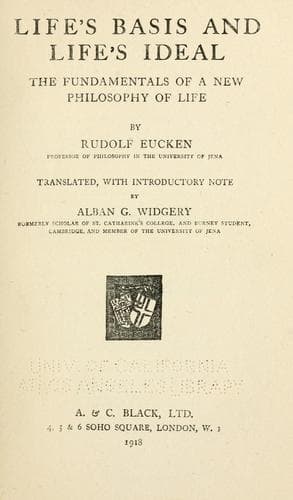
Life's Basis and Life's Ideal: The Fundamentals of a New Philosophy of LifeEucken, Rudolf
Philosophy
Life's Basis and Life's Ideal: The Fundamentals of a New Philosophy of Life
Eucken, Rudolf
Life; Ontology
In another direction complexities arise in that something objective is
evolved and established which, however, is not brought sufficiently into
relation with life as a whole and united with it. Then, work may
progress within its own province constantly and vigorously, but it loses
touch with our soul; we do not realise or develop ourselves in it. With
all the feverish tension of individual powers work is then inwardly
alien to us, and its power over us may become a heavy oppression.
Through such a detachment from life as a whole work loses soul and is
nothing more than mechanical; in short, we have all those results of
division between work and soul which we may feel with particular
acuteness in the contemporary state of culture. Experiences rising from
this division lead us to demand that work shall be so organised as to be
capable of taking up life as a whole into itself, and with this of
becoming our true self. Again, life as a whole cannot enter upon work as
complete, for then it would force something alien upon work, and by this
pervert it; life as a whole can be evolved only from the unification and
elevation of work itself. We do not begin and carry on work as a fixed
individuality, but we form individuality first through work by the
continual overcoming of the opposition of subjective disposition and
object. Spiritual contents are not produced by a communication of
something that is in itself complete to something else that is in itself
complete, an interaction of disposition and object; rather must we say
that genuine work sets both sides in motion and with elevating power
unites them in a single life. So understood, every movement which tends
to the development of spirituality in individuals, peoples, ages, and
finally of humanity as a whole, is a witness to the possibility of a
transcendence of this opposition, of the emergence of a reality within
the life-process.
We cannot give work a spiritual nature in this way, and make it the
instrument of a new reality, without being compelled to acknowledge that
there is much less genuine work among men than we are accustomed to
assume. On the other hand, we must also recognise that the little that
there is signifies much more, and indicates much greater advances of
life than it is usual to admit. Nothing differentiates individuals and
ages more from one another than the extent to which they take part in
genuine work; the degree to which they transform their life in such
work. Mere reflection and good will can accomplish very little in this
matter; without an energetic nature, a strong inner disposition with a
definite tendency, as well as the favour of destiny, not much can be
achieved. What is usually called "life" is only a will to live, a
straining after life; it yields but an outward appearance and a shadow
of life: genuine life is first brought forth by that transformation.
Public-domain text, read in full here on John Shaqi.
Reviews
Reviews
No reviews yet
Be the first to share your thoughts on this work.
Elsewhere in the archive
Join the Discussion
Join the discussion
Sign in to leave a comment or review.
Sign InorCreate an account