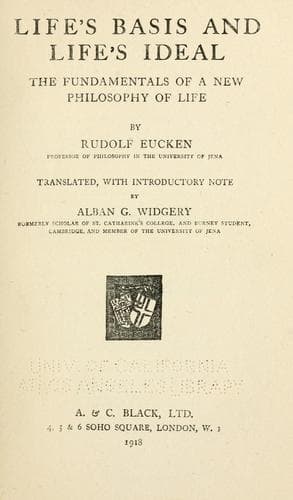
Life's Basis and Life's Ideal: The Fundamentals of a New Philosophy of LifeEucken, Rudolf
Philosophy
Life's Basis and Life's Ideal: The Fundamentals of a New Philosophy of Life
Eucken, Rudolf
Life; Ontology
But the less human existence in general immediately includes genuine
work, the more indispensable is it that there should be firmly rooted
tendencies to such work in the basis of our being, and that these
tendencies should be developed to greater clearness of form and to
greater effect in the work of universal history. So that our work may
not be split up and destroyed, we need definite syntheses that establish
a structure of life. On the one hand we must accomplish an analysis into
individual tendencies and departments of life which, operating
independently, generate life; and on the other hand we must find a unity
of endeavour among these tendencies and departments; a movement from one
to another; a common activity directed towards the building up of a new
world. These syntheses must be an immediate experience at each point;
they must be involved in all division of work; everywhere set
distinctive tasks; produce characteristic achievements; and in energetic
organisation of existence elevate it to the level of a characteristic
system of life, full of power, which presses forward to further
development. Only thus could a movement originate which might expand to
a real whole and be capable of establishing this whole against the world
as it is for immediate experience; only thus could humanity defend
itself against the power of the environment and of destiny.
Experience alone can decide whether our life contains such syntheses,
and whether by means of them it forms a whole: the movement of universal
history shows that there are such syntheses. The natures of these
syntheses give to the chief epochs of culture their distinctive
characters, by which the natures of their elements and of the relations
between them are determined; and man acquires a definite relation to
the world and can make a judgment upon it. Such a synthesis, with its
life-penetrating and life-forming power, certainly contains some truth;
it is not a product of narrowly human reflection and imagination. The
course of time and the changes of history, therefore, cannot simply
break it down completely; rather with the truth that it contains such a
synthesis elevates life above time into the eternal. But it has not been
demonstrated that life is capable of only one synthesis, or that it may
not produce a variety of such: life does not necessarily realise its
unity in simply establishing a single synthesis; it can seek unity in
the supremacy of a chief synthesis above others. That experience in our
own sphere of culture shows the latter to be the case we intend to
indicate in a few lines.
Public-domain text, read in full here on John Shaqi.
Reviews
Reviews
No reviews yet
Be the first to share your thoughts on this work.
Elsewhere in the archive
Join the Discussion
Join the discussion
Sign in to leave a comment or review.
Sign InorCreate an account