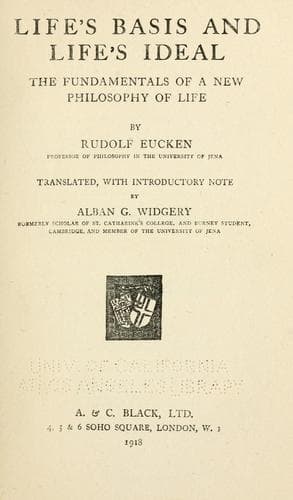
Life's Basis and Life's Ideal: The Fundamentals of a New Philosophy of LifeEucken, Rudolf
Philosophy
Life's Basis and Life's Ideal: The Fundamentals of a New Philosophy of Life
Eucken, Rudolf
Life; Ontology
A characteristic synthesis first made its appearance at the height of
classical Antiquity. It was art, chiefly plastic art, that determined
the nature of this synthesis. Form as a unifying and systematising power
is at the centre of life, takes possession of matter and organises it,
transforms chaos into a cosmos; and in this exercise of power it
realises itself, even though its fundamental nature is regarded as
transcending all change and variation. Spiritual work is formative and
selective; it is the triumphant realisation of form; it is necessary
that life in all its stages of development should be permeated by this
formative spiritual activity. There are numerous independent centres of
life, but the tendencies from each are towards the realisation of the
whole, and find their perfection in it alone.
Thought, independent of the world, must extract from the medley of first
impressions permanent forms, and unite these into a consistent
representation of the whole; it finds the acme of its achievement in
bringing this representation clearly to consciousness in a form that is
complete and free from subjective addition. In conduct, an organisation
and a unifying of the elements so as to produce a harmonious effect is
the chief thing. From the chaotic mass of individuals, the state by
constitution and law forms a living work of art, a differentiated
organism. For the individual the chief matter in conduct is to bring the
diverse forces in the soul into the right relation of order and
gradation, to reach the highest of all harmonies, the harmonious life.
All this involves particular estimates of value, a characteristic
solution of the problems and a harmonising of the oppositions of our
existence. It is a matter of general knowledge how this synthesis has
elevated and ennobled life, and is still increasingly felt as an
influence tending to further development and harmony. But it is equally
well known how the progress of life has rebuffed the claim of this
system of life to be the only valid one. We have become aware of
contradictions which do not find sufficient acknowledgment in this
system: a gulf deeper than it is able to transcend has made its
appearance between man and his environment: in particular, the supremacy
of form, which constitutes the basis of the system, has been shaken.
Antiquity, at its highest development, had, without much consideration,
given to form a living soul; its later course dissolved this union, the
soul degenerated more and more into an inwardness of feeling, and gave
up all claim, if not to the world, yet to its organisation and
formation: form, deprived of soul, threatened to become superficial, and
to change life into play and enjoyment. It was at this point that
Christianity intervened with a powerful effect, but it has not, in the
sense with which we are here concerned, produced an organised system of
life.
Public-domain text, read in full here on John Shaqi.
Reviews
Reviews
No reviews yet
Be the first to share your thoughts on this work.
Elsewhere in the archive
Join the Discussion
Join the discussion
Sign in to leave a comment or review.
Sign InorCreate an account