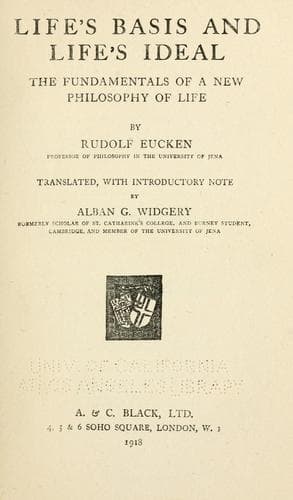
Life's Basis and Life's Ideal: The Fundamentals of a New Philosophy of LifeEucken, Rudolf
Philosophy
Life's Basis and Life's Ideal: The Fundamentals of a New Philosophy of Life
Eucken, Rudolf
Life; Ontology
Such a system was first produced in the Modern Age, and more
particularly in the period of the Enlightenment. This system makes force
the centre of life; to increase force without limit is the task of
tasks. The elements of reality are centres of force; but these elements
are not isolated, because force is called forth only by force, and the
amount of life depends on the degree to which relations are developed.
Since in this way one tends towards another, they become interweaved and
joined, and the many are united. For this system the world does not
appear as a work of art which rests in itself, but as a process that
ceaselessly increases in volume: the main achievement of spiritual work
is, with complete consciousness and self-determining activity, to take
possession of this process, which actually surrounds us; to change its
infinite life as much as possible into our own life, and to co-operate
to the best of our capacity for its advancement. Since here spiritual
work never tolerates a state of inactive peace, never accepts the world
as a rigid destiny, but is concerned to develop the world, to analyse
the world as it first appears into its elements in order to reach the
forces that move it, life acquires a more active relation to the
environment than it does in the earlier, more contemplative system, and
feels itself to be more in the workshop of reality.
The relation of knowledge and life is changed from its traditional
character. Research cannot transform the world from the apparent calm
and completeness of the immediate impression into movement and
development, without analysing the representation offered into its
ultimate elements; ascertaining their laws, and finally, with the help
of the idea of unlimited time, reconstructing from the beginning the
world, which it had first of all destroyed. With such destruction and
reconstruction modern research brings the world much nearer to us, and
gives us more power over it than does the earlier type. Corresponding to
the understanding of reality from its evolution, man finds his own life
in a progressive movement. Human society is regarded less as a
well-arranged work of art than as a complex of forces, which come to
full development and make sure progress only in their relation. The
chief demand is for the greatest amount of freedom of movement; the
greatest number of relations between individuals, and a ceaseless
increase of the stream of life, that should take up into itself all that
bear human features. The individual also must realise his existence as
one of "becoming" and motion; he is not bound by a closed standard of
nature. Through the power of his spiritual nature he is able to
assimilate ever new capacity, and to grow without limit: nothing gives
more proud courage and joyous force to his life than this consciousness
of an inner infinitude. A characteristic ideal of culture and education
is formed: all individual departments of spiritual work are now regarded
Public-domain text, read in full here on John Shaqi.
Reviews
Reviews
No reviews yet
Be the first to share your thoughts on this work.
Elsewhere in the archive
Join the Discussion
Join the discussion
Sign in to leave a comment or review.
Sign InorCreate an account