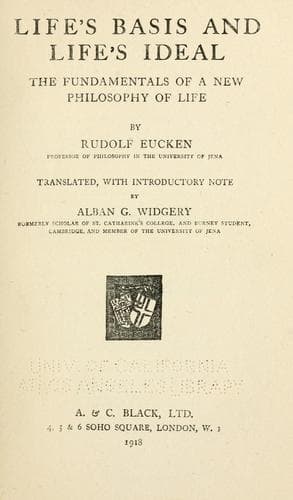
Life's Basis and Life's Ideal: The Fundamentals of a New Philosophy of LifeEucken, Rudolf
Philosophy
Life's Basis and Life's Ideal: The Fundamentals of a New Philosophy of Life
Eucken, Rudolf
Life; Ontology
knowledge beyond which there are possibilities of further developments.
From life as a whole the conflict will extend into all its individual
departments, and give to the activity in them a greater intensity.
Religion, art, and human society all have first to overcome the
opposition of subjective power and alien given condition, and thereby to
win a truth. In no case does truth mean a taking up of things which are
presented to the activity of life--it means rather an advance of life to
its own perfection.
In accordance with this conception of truth, that which claims to be
true will not be able to prove its right otherwise than through its
power, that is, through its capacity to embrace life as a whole and to
raise it above opposition into the state of complete activity. Every
such attempt must prove its power and its right in opposition to rivals
by being able to wrest from them the truth contained by them, and in new
relationships to lead beyond the state they reach, and to change life
more into a self-consciousness than they are able.
Hence the endeavour after truth here shows more movement, more freedom,
more multiplicity: different starting points and different ways may be
chosen, and the correctness of the one need not involve the
incorrectness of the other. The only indispensable thing is that the
movement pass beyond the state of division and reflection to one of
complete activity; only in that way can the content of life gain through
the movement of life. And so we see the great significance of progress
in work, in spiritual work; according as it succeeds, genuine life is
distinguished from the mere will to live. To be sure, each piece of work
that is here undertaken is a venture; it is far easier and far more
secure to continue in the state of mere reflection and reasoning. But
the latter does not lead us to an experience and a decision in a matter
concerning the development of life, and therefore does not bring us a
step further in this chief matter. Work with its failures is better than
all subtle contemplation which leads to no activity; for failure can
lead us beyond itself to truth, while feebleness and inactivity keep us
in the old position.
In our conception of it truth is anything but a system of universal
propositions out of which, by deduction, all detail might be derived.
Rather the organisation of life into an inner unity, upon which in this
view of truth everything depends, will exclude all that is only general
and turn towards the differentiation of the whole. The more life
progresses in this direction the less is it a mere application of
general principles; the less does it find its consummation after the
manner of a conclusion from given premises; the more does it become a
progressive activity, a new formation and an elevation.
Public-domain text, read in full here on John Shaqi.
Reviews
Reviews
No reviews yet
Be the first to share your thoughts on this work.
Elsewhere in the archive
Join the Discussion
Join the discussion
Sign in to leave a comment or review.
Sign InorCreate an account