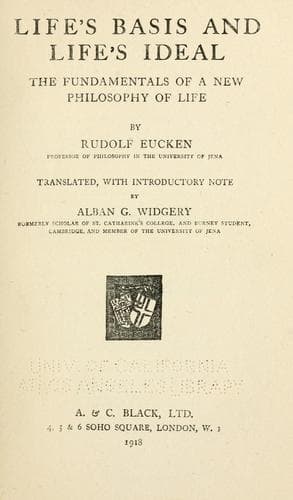
Life's Basis and Life's Ideal: The Fundamentals of a New Philosophy of LifeEucken, Rudolf
Philosophy
Life's Basis and Life's Ideal: The Fundamentals of a New Philosophy of Life
Eucken, Rudolf
Life; Ontology
In this conception, there is also room for a truth peculiar to the
single individuals. As the comprehensive life-synthesis can permeate
every individual detail of existence, so it is necessary for every
individual life-centre to realise its own particular synthesis, and that
every individual should fight for his inner unity and thus, also, for a
truth of his own; he must, however, realise this unity and truth in
every particular activity. A truth which is not my truth is, for me, not
a complete truth. Only it is necessary that such individualisation be
effected within the whole, not independent of it; it must result from
the inner necessity of creative activity, not out of a vain wish to
excel. In any case, it follows here that, as the immanent and universal
form of truth requires more activity and power, it is also able to grant
more free movement and multiplicity. Truth and freedom have been thought
opposed to one another in the course of history; if the former seemed to
require unconditional submission, the latter had a strong tendency to
shake off every tie as an oppressive yoke. If we see that truth of life
can be reached only through freedom, and also that freedom acquires a
content and a spiritual character only through its relation to truth,
the opposition by no means entirely disappears, but a basis is won upon
which we may strive to attain an agreement and a fruitful interaction
between the two.
* * * * *
So understood, the problem of truth has the closest connection with that
of reality: with regard to the one as to the other we are concerned in
a conflict against the external conception common to a naïve state of
life, which, though far surpassed by the inner movement of the work of
history, obstinately asserts itself through the evidence of the senses
in single individuals and hardly ceases to impress men with its apparent
self-evidence. The naïve way of thinking understands reality as a space
which encompasses men and things; reality seems to be presented,
"given," to man through the senses; only that which is exhibited to man
in these sense-relations passes current as real. In this Ptolemaic form
of life, dominated by sense impression, everything other than sense
fades to a mere illusion, and this includes the spiritual life itself,
although in it alone is reality known. Now, however, as science has with
no mean power led beyond this Ptolemaic representation of nature, so the
development of life has led beyond the Ptolemaic reality. Life could not
emancipate itself from its attachment to the environment and develop an
inwardness without effecting a revolution in this problem. The inward
becomes the first and surest experience, with which all that is to pass
current as real must show itself to be in consistent relation:
everything external loses its proximity and becomes a problem; it can be
established as real only through that which it achieves for the inner
Public-domain text, read in full here on John Shaqi.
Reviews
Reviews
No reviews yet
Be the first to share your thoughts on this work.
Elsewhere in the archive
Join the Discussion
Join the discussion
Sign in to leave a comment or review.
Sign InorCreate an account