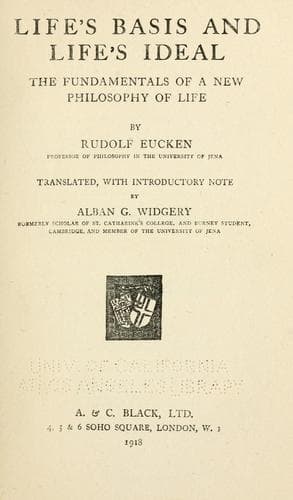
Life's Basis and Life's Ideal: The Fundamentals of a New Philosophy of LifeEucken, Rudolf
Philosophy
Life's Basis and Life's Ideal: The Fundamentals of a New Philosophy of Life
Eucken, Rudolf
Life; Ontology
be disdained, if it serves an important truth.
A universal character is shown most clearly by the movements that
co-operate towards the ethical moulding of life. Without freedom there
is no such moulding; but we saw above that freedom requires a world of
spontaneous life and its presence within man. However, when freedom is
thought of in these relations, it is elevated above the usual conception
of it and also above the usual criticism. All moral life is pretence and
delusion without the arousing and fundamental idea of duty. But where is
the truth more clearly expressed than in duty, that what man does by no
means concerns himself alone; and that nothing can constrain him but
what he acknowledges as his own will, his own being? As duty is
concerned ultimately not with something isolated but with a whole, not
with a performance within the old order but with the creation of a new
order, so in the moral life a whole new world appears to be taken up
into man's own will and being. Duty exhibits the new world particularly
in relation and in opposition to the old; the new world appears in
itself to be pre-eminently a kingdom of love. Love is primarily not a
subjective emotion, but an expansion and a deepening of life, through
life setting itself in the other, taking the other up into itself; and
in this movement life itself becomes greater, more comprehensive and
noble. Love is not a mere relation of given individuals, but a
development and a growing in communion, an elevation and an animation of
the original condition. And this movement of love has no limits; it has
all infinity for its development; it extends beyond the relation to
persons to the relation to things; for things also reveal their
innermost being only to a disposition of love. Again, the striving after
truth in science and art cannot succeed without love and an animation
that proceeds from it, without inwardly becoming one with the object.
How could this unity and activity in the whole be possible, how could
it even become an object of desire, if the whole itself did not strive?
And how could such a wealth of cultures proceed out of this movement if
that which was striven towards at one time was not taken up and carried
further by other times; how could the single movements tend together
without the unifying and elevating power of a universal life? As a
phenomenon to the individual, the movement involves a definite
contradiction: wherever it has been further and more freely developed it
has been directed to a kingdom of love; and this has necessarily been
thought of as the soul of reality, and a severe conflict has been taken
up against the world of self-assertion. Thus in the realm of morality
also we find ourselves in world-movements, we create out of the whole,
work towards the whole, and are borne on the flood of infinite life.
Public-domain text, read in full here on John Shaqi.
Reviews
Reviews
No reviews yet
Be the first to share your thoughts on this work.
Elsewhere in the archive
Join the Discussion
Join the discussion
Sign in to leave a comment or review.
Sign InorCreate an account