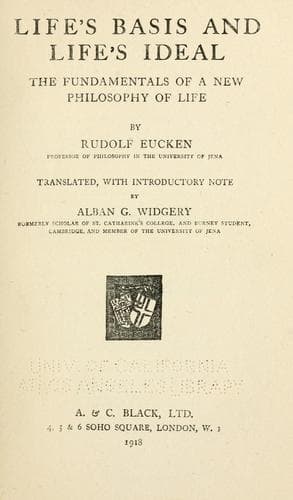
Life's Basis and Life's Ideal: The Fundamentals of a New Philosophy of LifeEucken, Rudolf
Philosophy
Life's Basis and Life's Ideal: The Fundamentals of a New Philosophy of Life
Eucken, Rudolf
Life; Ontology
Accordingly, life-developments of various and related kinds arise: with
their manifold experiences they strive to attain to a harmony and a
union with one another. They can seek these only on the basis of a
self-consciousness of reality; find them only through their unification
in a universal life, to which each individual tendency leads.
Representations of the whole are attempted at the highest points of
creative activity by philosophy, religion, and art; these
representations accompany, indeed govern, the work in these spheres of
life through history. But the limitations of our capacity, through which
we are unable to give a suitable form to necessary contents, and through
which we attribute and must attribute human traits to that which should
lead us beyond the human, are of particular force in this matter of
forming a representation of the whole; and, indeed, this is the more so
the further we remove ourselves from that which may be immediately
transformed in work. These representations of the whole are, therefore,
inadequate; their content of truth is clothed in a wrapping of myth, and
humanity lies under the danger of taking the myth for the chief thing
and thus of obscuring the truth, and this must produce an incalculable
amount of error and strife. Still, it is impossible to give up all claim
to these representations of the whole; for they alone make the fact of
our belonging to the whole and of the presence of the whole in our life
quite clear and enable it to exert a far-reaching influence. Only with
their help can the degeneration of life to the intolerable
insignificance of the narrowly human be resisted; only with their help
can a movement from whole to whole begin.
Thus it is a matter not so much of abandoning these representations of
the whole as of referring them continually to their essence; to those
unfoldings of life which are experienced by us; to test them by these
and to renew them from these. It was the error of the earlier
position--much too indulgent to Intellectualism-that it did not
sufficiently maintain the relation with these living sources, and so
fell into the danger of having no definite tendency, or even of failing
to recognise the relativity of the myth. If a more energetic direction
of life upon its own content and experiences teaches us to preserve
these connections better and to develop them more forcefully, a new type
of representation of the whole is yielded in contrast to the old, and
far more different from it than may appear at the first glance. We may
hope that with its development the truth will be seen more clearly
through the myth, and that the striving, which we cannot give up, to win
a universal life may not lead us astray into a world of dreams.
(c) THE MOVEMENT OF THE SPIRITUAL LIFE IN MAN
Public-domain text, read in full here on John Shaqi.
Reviews
Reviews
No reviews yet
Be the first to share your thoughts on this work.
Elsewhere in the archive
Join the Discussion
Join the discussion
Sign in to leave a comment or review.
Sign InorCreate an account