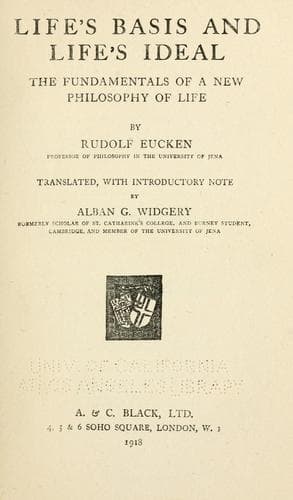
Life's Basis and Life's Ideal: The Fundamentals of a New Philosophy of LifeEucken, Rudolf
Philosophy
Life's Basis and Life's Ideal: The Fundamentals of a New Philosophy of Life
Eucken, Rudolf
Life; Ontology
To make nature completely active, and to unify that which
it offers in a scattered and an unsystematic manner, appears to be our
whole life-work.
The result, therefore, is a powerful, active, self-conscious life, which
not only affects us by its results but to which we must assign a
permanent significance. But as the only and exclusive form of life, it
involves great restrictions and rigour; its limitations may remain
hidden in days of joyful creative activity and in the highest circles of
society, but they must be keenly felt if life falls into a condition of
stagnation, and man, as man, asks questions with regard to the
happiness of life. This destiny may then become an intolerable
compulsion; mere courage, an over-exertion of human power; mere justice,
severity and unmercifulness; the sharp distinction between men, an
actual separation, which tends on the one side to proud haughtiness and
on the other to doubt and depression. A keen perception of such
limitations and dangers must necessarily force life into new paths.
The counter movement has won the victory in Christianity, which makes
not work in the world but the relation to a world-transcendent spiritual
life the chief thing. Man does not in the first place trust a nature
that safely leads him but at the same time limits him; but his nature
seems full of problems, and to need a complete transformation, which
only a miracle of grace can accomplish. Men are not regarded as being
separated by fixed differences, but in comparison with the divine
perfection all differences vanish, and from the relation to God the
feeling of equality and brotherhood is evolved. Thought of in relation
to the requirement of a pure inwardness of the whole being, differences
in achievement are totally insignificant: justice gives place to an
infinite love that dispels all harshness, makes all differences
consistent and harmonious, and tolerates no feeling of hostility.
The antithesis of a nature which is operative within the world and which
elevates above the world must permeate life as a whole and must give
rise to opposite tendencies in every part of life. On the one hand,
there is a distinct formation in finite relations, an insistence upon
plastic organisation and complete consciousness of life; on the other,
an aspiration towards the infinite, a more submissive faith, a more
unrestrained disposition, a higher estimate of the naïve and the
childlike. In the former, man, full of confidence in his own power,
himself produces a rationality of reality, and disdains all aids alien
to himself; in the latter, life is sustained by a trust in an infinite
good and power which, in a way transcending the capacity of man, guides
to the attainment of the best; in short, as a whole and in its
individual aspects each is a fundamentally different type of life from
the other.
Public-domain text, read in full here on John Shaqi.
Reviews
Reviews
No reviews yet
Be the first to share your thoughts on this work.
Elsewhere in the archive
Join the Discussion
Join the discussion
Sign in to leave a comment or review.
Sign InorCreate an account