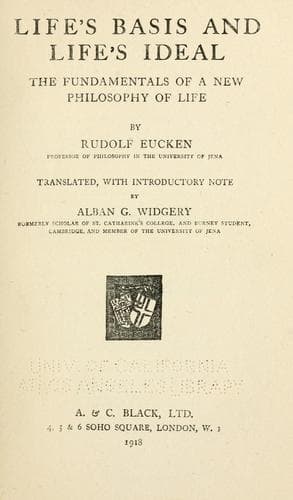
Life's Basis and Life's Ideal: The Fundamentals of a New Philosophy of LifeEucken, Rudolf
Philosophy
Life's Basis and Life's Ideal: The Fundamentals of a New Philosophy of Life
Eucken, Rudolf
Life; Ontology
The type of life advocated by Christianity has resulted in a great
deepening of life; it cannot possibly be given up again in favour of an
earlier type. But this Christian type also does not suffice for the
moulding of life as a whole. Most severe complications would ensue if
the position of Christianity were taken up as an ultimate conclusion and
an absolute evaluation in the conditions which at present exist, and its
principles without further consideration were applied to our life as a
whole. The annulling of all differences, even of spiritual capacity; the
displacement of justice through pity; the cessation of the conflict
against evil; the low estimate of man's own power, would all endanger
most severely the rational character of life; an adoption of this type
of life in its entirety would lead to the discontinuance of the work of
culture; in particular, it is inconsistent with any kind of political
organisation. Finite conditions are not to be judged by infinite
standards; and we men are, after all, in the finite and remain so.
And so, from the earliest times since Christianity, from being merely
one of opposing systems, became the dominant power, compromises have
been sought. The system of the development of power and of justice has
nevertheless asserted its influence, and though Christianity has had an
external supremacy, this system has forced characteristically Christian
life to be regarded as a matter of mere subjective disposition and of
private life. But as such compromises do not fully and truly express
spiritual necessity, they easily lead to falsity. To rise above this
tendency to make such compromises, the acknowledgment of the right and
of the limits of each type, the acknowledgment of the necessity of both
within a comprehensive whole, is necessary. Such a whole and along with
it a common ground, upon which the movements meet together, and can
strive to understand one another, is given to us by the spiritual life,
acknowledged in its independence. It is not for us to force our life
into a finished scheme, but to develop fully and to acknowledge the
movements and oppositions which exist in our life. True, life will ever
remain unfinished, but can we wish to make it more complete than it can
be, and can the incompleteness cause us anxiety, when we are sure of its
main direction?
III
APPLICATION TO THE PRESENT
CONSEQUENCES AND REQUIREMENTS
_Introductory Considerations_
With a consideration of the present we set out: to the present we now
return. The convictions at which we have arrived, and which have led us
to a characteristic philosophy of life, must now be considered in
relation to the needs of the present; we must see whether this
philosophy proves to be true in this connection, and this by its own
development, as well as by the simplification of the condition of a
time, which, as it is immediately experienced, is confused in the
highest degree.
Public-domain text, read in full here on John Shaqi.
Reviews
Reviews
No reviews yet
Be the first to share your thoughts on this work.
Elsewhere in the archive
Join the Discussion
Join the discussion
Sign in to leave a comment or review.
Sign InorCreate an account