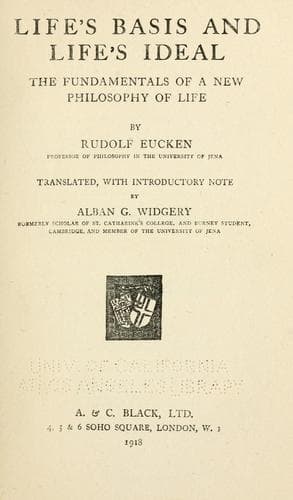
Life's Basis and Life's Ideal: The Fundamentals of a New Philosophy of LifeEucken, Rudolf
Philosophy
Life's Basis and Life's Ideal: The Fundamentals of a New Philosophy of Life
Eucken, Rudolf
Life; Ontology
But, at the outset of our treatment of this problem, we perceive how
difficult it is for the acknowledgment of an independent spirituality to
determine our relation to the temporal environment; we see how this
acknowledgment transforms that relation into a problem. The conception
of the "present" is by no means simple and certain, even as far as its
external boundary is concerned. The mere to-day is obviously too short a
period to constitute the present; but how much is to be added and where
must it cease in order that we may have a genuine present? True, the
present must involve a characteristic content that associates the
moments and unites them so as to produce a common effect; but does our
time give us such a content? The first glance at the state of life in
our time reveals a chaotic confusion, which includes the most diverse
endeavours, now in passionate union, now in complete indifference to one
another, and yet again in harsh hostility; further, there is a constant
displacement of the individual elements by a process of elevation and of
degradation. Even if something common and permanent is operative in the
present, its close amalgamation with this change and movement prevents
it from being purely developed: the truth contained in the present state
of life is inseparably mixed with human error and passion.
And yet this is not an experience simply of the present, but one common
to all ages. For fundamental spiritual creation has always been effected
in the direst contradiction to the social environment. What harsh
judgments, and judgments that set its value at nil, have been passed
upon society with regard to its capacity not only in religion but also
in philosophy and art! How severe a conflict has been carried on in all
departments of life against the presumption of society! The present,
especially, is troubled by these problems, because, as has become
evident to us from the beginning of our investigation, it carries within
it movements of a diverse and contradictory nature, so that it can
hardly produce a consistent impression of the whole, still less attain
to a definite character. Human interests and parties seek with all their
energy to impress upon the time their own character; they call that
modern which is useful to and in harmony with themselves. The most
diverse tendencies cross one another; experiences in particular
departments of life determine the conception of the whole; the different
classes of society follow different courses in accordance with their
different interests; much that is accidental is regarded as vital and is
allowed to influence us: the extreme has the advantage of being able to
make an impression upon us; and the superficial and the negative creep
into favour through the easiness of the conclusion presented by them: in
short, in this state of the time, that which arises in human opinion is
incapable of offering to spiritual endeavour a secure support and an
orientation concerning its aims.
Public-domain text, read in full here on John Shaqi.
Reviews
Reviews
No reviews yet
Be the first to share your thoughts on this work.
Elsewhere in the archive
Join the Discussion
Join the discussion
Sign in to leave a comment or review.
Sign InorCreate an account