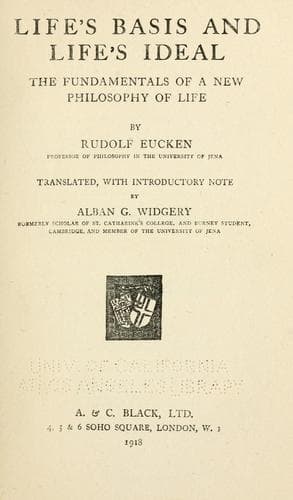
Life's Basis and Life's Ideal: The Fundamentals of a New Philosophy of LifeEucken, Rudolf
Philosophy
Life's Basis and Life's Ideal: The Fundamentals of a New Philosophy of Life
Eucken, Rudolf
Life; Ontology
This uncertainty cannot be removed by turning our attention to history,
by taking an interest in past ages. For, with whatever clearness a
highly developed science of history may present the whole course of the
ages to us, to believe that our own life is enriched and made more
stable by this, we must confuse knowledge and life, the mere present
representation of earlier times and the appropriation of them by our own
activity--a danger into which the purely academic mode of thought easily
falls. The power and the tendency of life in the present determine the
nature of our appropriation of the past and of its transformation in
self-determining activity. If this life stagnates, then we are helpless
in face of the stream of earlier systems of thought. Even if these
systems attract us to themselves, and carry us with them for a time,
finally they will manifest their antitheses and throw us back again upon
ourselves: we cannot escape from ourselves; we can never find a
substitute from outside for want of conviction and power of our own. It
is a fundamental error, not, indeed, of historical research but of a
feeble historical relativism, to expect us to form a conviction of our
own by concerning ourselves with the past; and to think that the later
stage in history proceeds from the earlier as a self-evident final
result. By taking such an attitude to the past we should only fall into
the half-will and half-life common to an age of decadence. If the
present is thus uncertain in the heart of its spiritual nature, and it
is not possible to escape from this uncertainty by resorting to the
past, it may appear to be essential that we should be completely
delivered from the tyranny of time, and that we should take up an
attitude of entire unconcern of its affirmation and its negation of
spiritual endeavour.
But a rejection of the immediate relation to time by no means settles
the matter. If spiritual work were completely dissociated from the
temporal environment and the historical movement, it would be dependent
solely upon the capacity of the mere individual and upon the passing
moment; all relation, all community of work, would thus be given up, and
the performance of others could not be anything to us, nor our
achievement anything to others; there would be no inner building up of
life, and no hope of reaching greater depths. Not only is it impossible
to abandon such aims, but our experience of spiritual work itself
contradicts the disintegration of life into nothing but isolated
points. If all spiritual creation is effected in contradiction to time,
what is denied in this contradiction is rather that which lies upon the
surface of time than that which is deeper; rather human accommodation to
than the spiritual content of time. All who believe that distinctive
human history is sustained by the activity of a spiritual life will
attribute to time such a spiritual content.
Public-domain text, read in full here on John Shaqi.
Reviews
Reviews
No reviews yet
Be the first to share your thoughts on this work.
Elsewhere in the archive
Join the Discussion
Join the discussion
Sign in to leave a comment or review.
Sign InorCreate an account