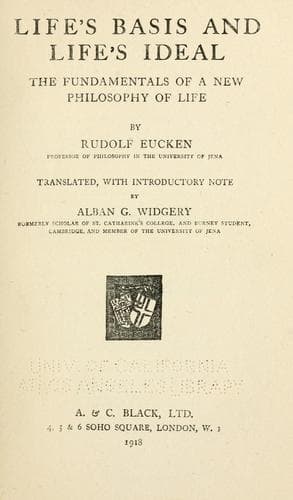
Life's Basis and Life's Ideal: The Fundamentals of a New Philosophy of LifeEucken, Rudolf
Philosophy
Life's Basis and Life's Ideal: The Fundamentals of a New Philosophy of Life
Eucken, Rudolf
Life; Ontology
Every age, therefore, in virtue of the presence of this spiritual life,
will contain characteristic spiritual motives, movements, and demands,
and will be especially qualified to convey certain contents to man, to
open up certain experiences to him, and to point out certain directions.
All these must be appropriated by anyone who wishes to transcend the
original state of emptiness, and to advance to spiritual creation and to
a spiritual fashioning of life. In consequence of this a more friendly
attitude may be taken up towards time; and we shall be far more grateful
to it--though perhaps not with explicit consciousness, perhaps even in
contradiction to definite purpose--than we could ever be with regard to
the experiences on the surface of time. However low, for example, the
estimate Plato may have formed of "the many" around him; and though with
the whole passion of his soul he may have insisted upon a transformation
of the immediate condition of life, what he offered of his own and the
new that he required, with all its originality and uniqueness,
contradicts neither the natural spirit of the Greek nor the contemporary
Greek culture: Plato can be regarded only as a Greek of a particular
time. His conflict with the time is not the conflict of an incomparable
individuality with his environment, but a selection and a unification of
the possibilities existing in time; it is an arousing to life of the
deeper realities of time against its superficialities, of spiritual
necessities in opposition to the conduct and interests of men. In this
manner the great man also is a child of his age, and is unintelligible
out of relation to it. Could one think of Goethe as living in the Middle
Ages, or of Augustine as living in the age of the Enlightenment?
Indeed, we may carry our contention further, and say that the great has
been just that which has had the closest relation with the time; and
that it has reached a permanent significance, just because it expressed
the unique nature and the inner longing of the time, that which was
incomparable and inderivable in it. That which has been able to work
permanently beyond the time in which it made its appearance was born not
from a timeless consideration of things, but from the deepest feeling of
the needs of the time; only thus can we escape from the feeling of
unreality which otherwise accompanies the striving after spirituality.
This consideration must commend to spiritual work the closest possible
relation with the time, and the spiritual life may hope for an essential
advance of its own striving as a result of this relation.
Public-domain text, read in full here on John Shaqi.
Reviews
Reviews
No reviews yet
Be the first to share your thoughts on this work.
Elsewhere in the archive
Join the Discussion
Join the discussion
Sign in to leave a comment or review.
Sign InorCreate an account