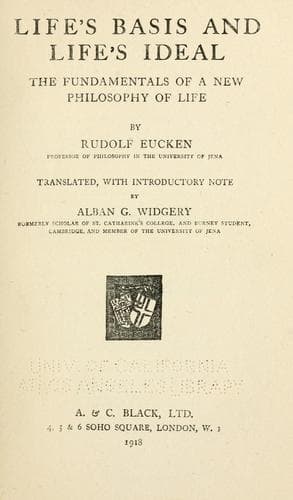
Life's Basis and Life's Ideal: The Fundamentals of a New Philosophy of LifeEucken, Rudolf
Philosophy
Life's Basis and Life's Ideal: The Fundamentals of a New Philosophy of Life
Eucken, Rudolf
Life; Ontology
Still, the matter is not so simple as it is often thought to be. The
spiritual content of the ages is not a complete fact that permeates life
with a sure and definite effect, so that it could be taken up by
activity. Rather, that which is great and characteristic in the ages is
found only in creative spiritual activity, abstracted from which it is
no more than a possibility; a suggestion that is inevitably lost, if an
advancing spiritual activity is lacking. Spiritual creation is not a
mere copy, an employment of an existent time-character. Rather, time
first attains a spiritual character through spiritual activity, and by
spiritual creation possibility first becomes complete reality. This
spiritual creation is not simply a summation but a potentialisation, an
essential elevation of that which exists in time. Without this activity
the spiritual elements in time remain merely coexistent, and have no
living unity; they realise no life of the whole, no being within the
activity, nothing that means to us development of being. Temporal life
then remains only a half-life, a life of pretence; it lacks complete
self-consciousness and true stability and joy, and at the same time it
lacks a genuine present. To attain such a present thus appears to be a
difficult task, the performance of which is not so much presupposed by
the different branches of spiritual life as is an object of their work.
Art, for example, is rightly required to express the feeling of the life
of the time; yet it does not find such a feeling of life already
existent, but it must first wrest it from the chaos of the general
condition of life. Art is great in giving to the time that which it did
not already possess, but which is, nevertheless, necessary to the
complete reality of its life. Spiritual work, therefore, is not
something just added in time, but that which first gives to time a
genuine life and a genuine present. This task may be achieved with quite
different degrees of success; it is not all times that reach this
elevation and attain to a genuine present; those that do so we call
great and "classical" times. The general state of our life--which,
however, does not imply time as a whole--appears from this point of view
to be especially afflicted with the defect and fault of insincerity; our
age does not so much live a life of its own as a strange life; and yet
this life is represented as being a life of our own. And it is
especially so in our own time, when along with a state of division in
our own purposes we are inundated by systems of thought alien to us. We
are thus in danger of becoming half-hearted and living a life of
pretence: in religion we assert the profession of faith and the feelings
of times long gone by to be our own conviction and feelings; we build
our cathedrals in styles that correspond to another spiritual condition
and another tendency of life; in philosophy we hang upon systems and
problems of other times; in everything we lack sincerity. But why is
Public-domain text, read in full here on John Shaqi.
Reviews
Reviews
No reviews yet
Be the first to share your thoughts on this work.
Elsewhere in the archive
Join the Discussion
Join the discussion
Sign in to leave a comment or review.
Sign InorCreate an account