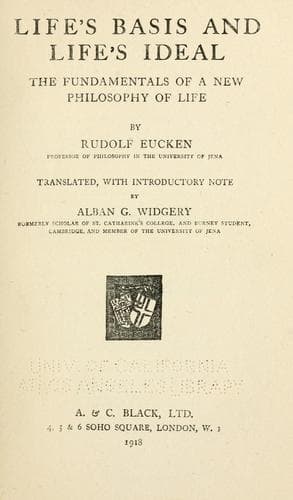
Life's Basis and Life's Ideal: The Fundamentals of a New Philosophy of LifeEucken, Rudolf
Philosophy
Life's Basis and Life's Ideal: The Fundamentals of a New Philosophy of Life
Eucken, Rudolf
Life; Ontology
this so, and why do we renounce all claim to a life in accordance with
our own nature? Certainly not because our time lacks problems and tasks
of its own, or because it is deficient in spiritual possibilities and
necessities; for, of these there is an abundance; in this matter our
time is not behind any other. But there predominates a wrong relation
between these tasks and the central power of the spiritual life, which
is equal to cope with them and out of the possibilities create a
reality.
In any case spiritual work has a great deal to do with the time; and in
regard to this it finds itself in no simple situation. Spiritual work
must acknowledge a given condition, which it cannot alter to suit its
own preferences; but it can make something else out of this condition
and also see something else in it than immediately meets the eye. The
possibilities of a time are revealed only in spiritual work, and through
it alone are they separated from the human additions that usually
overgrow them. These possibilities cannot become clearly evident, unless
a close relation to history is won: they are not suggestions simply of
the moment, for they have been prepared by the whole work of history.
History acquires quite a different--a far more positive--meaning when
the spiritual life is acknowledged to be independent, and when it is
admitted that spiritual life is not just the embellishment of a reality
other than spiritual, but the formation of the only genuine and
substantial reality, the transition to a self-consciousness of life.
For, as such a formation of reality, this creative activity extends
beyond the particular time in which it originates, and becomes part of a
time-transcending present. True, this activity always appears in a
garment that seems simply temporary; but this garment does not
constitute its being: the imperishable in it, its fundamental life,
remains inwardly near and present even after great changes of temporal
condition; and within the sphere of spiritual work is always capable of
new effect.
Christianity, for example, in spite of the attacks that are and have
been made upon it, still asserts itself as a living power. Yet there
cannot be the slightest doubt that in everything that lies on the
surface of our life we are as far as possible removed from the centuries
of its formation; that not only the view of the world but also the tasks
of life and the nature of feeling and disposition have become radically
different. But life is not exhausted in these activities on the surface,
which must be regarded as external manifestations that proceed from an
inner unity. That which these centuries have performed for the essence
of life: the realisation of a freedom of spiritual inwardness, the
acknowledgment of an independent spiritual world with great aims and
tasks, may, indeed, become obscured for the consciousness of individuals
and of whole periods; it remains, however, an essential part, a
presupposition of all further spiritual life.
Public-domain text, read in full here on John Shaqi.
Reviews
Reviews
No reviews yet
Be the first to share your thoughts on this work.
Elsewhere in the archive
Join the Discussion
Join the discussion
Sign in to leave a comment or review.
Sign InorCreate an account