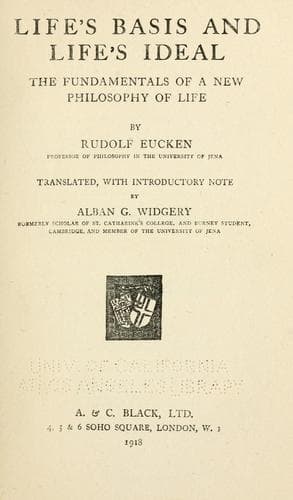
Life's Basis and Life's Ideal: The Fundamentals of a New Philosophy of LifeEucken, Rudolf
Philosophy
Life's Basis and Life's Ideal: The Fundamentals of a New Philosophy of Life
Eucken, Rudolf
Life; Ontology
As in this manner in the case of Christianity, spiritual reality has
also been evolved otherwise in some creative epochs; and in the movement
of history they have all together produced a certain condition of
spiritual evolution which constitutes the invisible basis of our own
activity, and from which it is first possible to elucidate the spiritual
nature of a particular time. This universal, historical state of
spiritual evolution indicates a level, to which must correspond all
work, which desires not simply to attain the aim of the moment but also
to serve in the building up of a spiritual reality within the domain of
humanity. This historical condition of the spiritual life is not
conferred upon us by history; rather history only mediates an incentive
that must first be transformed by our own activity and conviction. Only
a mode of thought which transcends the movement of history can recognise
a spiritual content in history and in our own time, and use this content
for our own striving.
Spiritual work, therefore, and philosophy as part of it, has a twofold
relation to time, a negative and a positive: it must possess an
independence of time, and it must seek an intimate relation with it. The
"modern," according to the sense in which it is taken, will arouse us at
one time to energetic opposition, at another to the closest intimacy;
the former when it desires to subject us to the contemporary conditions
with all their contingency, the latter when it champions the spiritual
possibilities of the time and the state of spiritual evolution in
contrast with the human. We are concerned in a conflict for genuine
against false time; we are to distinguish clearly between the merely
human and the spiritual present; the spiritual life must first give a
genuine reality to time, and in doing this must advance in itself.
Every particular philosophic conviction must justify itself in its
treatment of this problem; it must be in a position to wrest the truth
from the error in time; to understand and to estimate the endeavour of
the time without yielding to it; to comprehend as a whole the manifold
elements of truth in the life of the present, and to elucidate them from
a transcendent unity. Without doubt great problems and fruitful
possibilities exist in the time, but we often feel the most painful
contrast between their demands and the achievements of man. To diminish
this divergence; for the time to attain more to its own perfection and
become a genuine present, is an urgent task in the performance of which
philosophy also must co-operate; and by this endeavour philosophy can
also gain much for itself.
I. REQUIREMENTS FOR THE FORM OF LIFE AS A WHOLE
(a) THE CHARACTER OF CULTURE
Public-domain text, read in full here on John Shaqi.
Reviews
Reviews
No reviews yet
Be the first to share your thoughts on this work.
Elsewhere in the archive
Join the Discussion
Join the discussion
Sign in to leave a comment or review.
Sign InorCreate an account