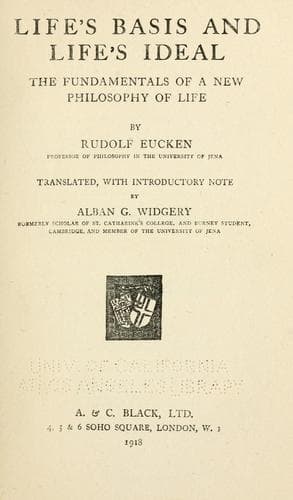
Life's Basis and Life's Ideal: The Fundamentals of a New Philosophy of LifeEucken, Rudolf
Philosophy
Life's Basis and Life's Ideal: The Fundamentals of a New Philosophy of Life
Eucken, Rudolf
Life; Ontology
The term "culture" received its present meaning in the latter half of
the eighteenth century; culture itself reaches back to the beginning of
the Modern Age. The whole evolution of the Modern Age is a striving
beyond the religious form of life which prevailed in the Middle Ages,
and which began to be felt to be narrow and one-sided. In opposition to
this type of life a new type arose, increased in strength, and finally
we became fully conscious of it in the idea of culture. The new type has
been felt to be far superior to the old in many ways; it is not limited
to one side of human nature, but desires to take it, and to develop it
as a whole; it does not refer man to any kind of external aid, but makes
his life depend as much as possible upon his own power, and finds an aim
fully sufficient in the limitless extension of this power; it directs
man's perception and endeavour not so much beyond the world as to it,
and hopes by this means to give a stability to his striving, and a close
relation with the abundance of things. The movement has brought about a
far-reaching transformation of life: that which was lying dormant has
been aroused; the rigid made plastic; the manifold woven into a whole of
life; the whole range of life has acquired more spontaneous freshness
and inner movement. The result of the work of history now becomes for
the first time a complete possession, since above everything contingent
and accidental it elevates an essential, and above everything tending to
separation and hostility, a common humanity.
The animating and ennobling influence of modern culture is nowhere more
manifest than in the life-work of Goethe. For we recognise the greatness
of his nature primarily in that, with the acutest vision and the
greatest freedom, he entered into the multiplicity of experience and
events; with placid yet powerful dominance stripped off all that was
mere semblance and pretence, all that was simply conventional and
partial, and fully realised the genuine, the freshness of life, and the
purely human. (_V._ "The Problem of Human Life.") His treatment of
Biblical narratives is a good example of this: that a king reigned in
Egypt who knew not Joseph suggests to him how quickly even the most
magnificent human achievements are forgotten; that Saul went forth to
find his father's she-asses, and found a kingdom, symbolises to him the
truth that we men often reach something totally different from, and also
much better than, that for which we strove and hoped; the miracle of the
walking on the water is to him a parable of unflinching faith--the
holding fast to apparent impossibilities--without which there can be no
great creation.
Public-domain text, read in full here on John Shaqi.
Reviews
Reviews
No reviews yet
Be the first to share your thoughts on this work.
Elsewhere in the archive
Join the Discussion
Join the discussion
Sign in to leave a comment or review.
Sign InorCreate an account