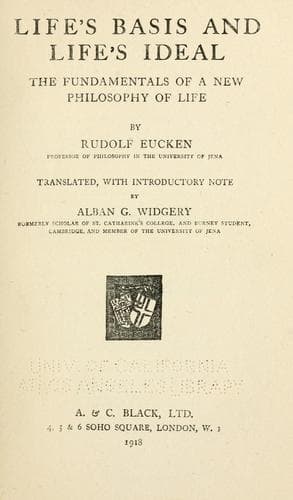
Life's Basis and Life's Ideal: The Fundamentals of a New Philosophy of LifeEucken, Rudolf
Philosophy
Life's Basis and Life's Ideal: The Fundamentals of a New Philosophy of Life
Eucken, Rudolf
Life; Ontology
If, with this achievement, modern culture may have the feeling of being
the fulfilment of the strivings of the ages, yet its own course has
produced oppositions, and engendered perplexities that culminate in a
dangerous crisis. Culture, as it was represented at the height of German
spiritual life, was directed chiefly towards the inner development of
man; it was called with especial satisfaction "spiritual culture." Its
adherents were concerned not so much with finding a better relation to
the environment as with growing in the realm of their own soul, and with
employing whatever the experience of life brought in the development of
a self-conscious personality, of pure inwardness. Only in this way did
they seem to advance from the previous state of limitation to the
complete breadth of existence, and the exercise of all their powers. A
joy in life, a firm confidence in the rationality of reality gave this
inner culture a soul; and a bold flight bore it far above the narrowness
and heaviness of daily life; æsthetic literary creation became the
chief sphere of its work, and the chief means for the development and
self-perfecting of personality.
Inner culture has by no means vanished from our life; effects of many
kinds are felt from it in the present. But it has been forced to resign
its supremacy in favour of a realistic culture, which makes the relation
to the environment the chief matter, and removes the centre of life to
the intellectual and practical control of this environment. In realistic
culture the inner development of work, of work in the direction of
natural science and technical art, as well as in politics and social
endeavour, is less occupied with the acquiring of a powerful
individuality than with the establishment of an agreeable condition of
society as a whole. Since activity is related more and more closely with
things, and receives laws and directions from them, culture is freed
from dependence upon man and his subjectivity. Culture is an impersonal
power in contrast with man; it does not lead ultimately to a good to him
so much as make him simply a means and an instrument of its progressive
movement. An immeasurable structure of life, a ceaseless self-assertion
and self-advancement, an arousing and an exertion of all powers that can
bring man into relation with the environment, are manifest in this
culture: but at the same time there is an increasing transformation of
our life into a mere life of relation and mediation, a deprivation and a
vanishing of self-consciousness. In the midst of the magnificent
triumphs in external matters there is an increasingly perceptible
contrast between an astonishing development of the technical, and a
pitiful neglect of the personal side of life: in regard to the former we
surpass all other times, as much as we fall below most in regard to the
latter. Along with a ceaseless increase of technical capacity, there is
a rapid degeneration of personal life, a pauperising of the soul. Where
Public-domain text, read in full here on John Shaqi.
Reviews
Reviews
No reviews yet
Be the first to share your thoughts on this work.
Elsewhere in the archive
Join the Discussion
Join the discussion
Sign in to leave a comment or review.
Sign InorCreate an account