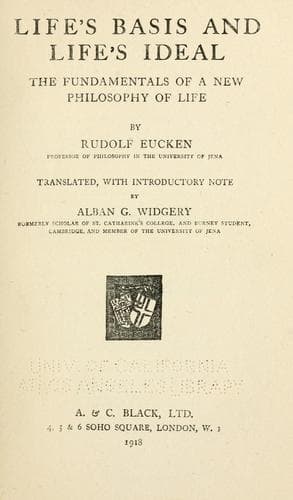
Life's Basis and Life's Ideal: The Fundamentals of a New Philosophy of LifeEucken, Rudolf
Philosophy
Life's Basis and Life's Ideal: The Fundamentals of a New Philosophy of Life
Eucken, Rudolf
Life; Ontology
the matter is one of a technical nature there is a magnificent
condition, definite progress in all departments, work conscious of its
aim; but there is a painful groping and helpless hesitation, a
stagnation of production, an emptiness that is only just hidden by a
veneer of academic education, where powerful personalities and
impressive individualities are required.
For a time we were carried away entirely by the tendency to place our
attention solely upon the environment, and we seemed to be satisfied
absolutely by it. But the inner life that has been evolved within human
experience by the work of thousands of years, and through severe
convulsions, prevents this condition being accepted as a conclusion;
that which has once become an independent centre cannot possibly permit
itself to be degraded to the position of a mere means and an instrument.
It is impossible to give up all claim to self-conscious and
self-determining life and a satisfaction of this life. Our spiritual
nature compels us to ask questions and to make claims; if they are not
satisfied, then, notwithstanding all the wealth of experiences, the
feeling of poverty spreads and we seek for aids, and, first, we turn
back to that inner culture from which we had turned away. But we find
the ways shut off; a direct return is impossible. This culture had
characteristic principles and presuppositions; and the course of modern
life itself has, if not overthrown them, involved them in serious doubt.
We have become clearly conscious of the limitations which this inner
culture had without itself feeling them; movements which it united have
now separated, and have become hostile. Inner culture rested on a firm
faith in the power of reason in reality, and this faith begot a joyful
confidence. For it the world was sustained and determined by inner
forces: we feel the rigid actuality of occurrences, the indifference of
the machinery of the world towards the aims of the spirit, and the
contradictions of existence. In the former case the greatness of man was
the predominant faith; and this greatness was sought in his freedom: we,
however, feel much more our bondage to obscure powers and at the same
time our insignificance. In the former again, it aroused no opposition
to call only a chosen part of humanity, the creative, to full and
complete life, and to assign a most meagre portion to the majority: we
cannot possibly renounce the concern for all mankind and for the
welfare of every individual. In the former, morality and art were
harmoniously united in the ideal of life; in our time they have
separated and are at deadly enmity with one another. Everywhere life has
given rise to more problems, more inconsistencies, more obscurities;
thus, with all its external proximity, the joyfully secure ideal of life
of our classical writers is inwardly removed far from us; without
insincerity we cannot proclaim it to be our profession of faith. In
Public-domain text, read in full here on John Shaqi.
Reviews
Reviews
No reviews yet
Be the first to share your thoughts on this work.
Elsewhere in the archive
Join the Discussion
Join the discussion
Sign in to leave a comment or review.
Sign InorCreate an account