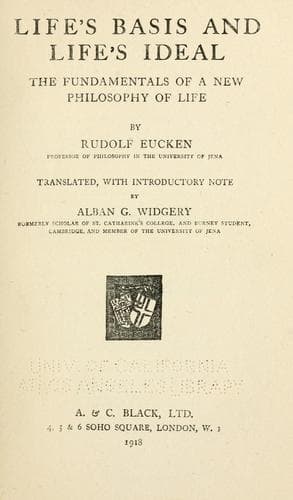
Life's Basis and Life's Ideal: The Fundamentals of a New Philosophy of LifeEucken, Rudolf
Philosophy
Life's Basis and Life's Ideal: The Fundamentals of a New Philosophy of Life
Eucken, Rudolf
Life; Ontology
We find ourselves therefore in the present in a difficult situation with
regard to the organisation of culture. To give up the independence of
the individual departments, or even only to limit it in any way, would
be an enormous and impossible retrogression; on the other hand, some
kind of inner unity of life must be obtained. A transcendence of the
antithesis must, therefore, be sought; and this needs a distinctive
structure of life. The spiritual life offers such a structure in so far
as it constitutes the development of being. For we saw how independent
centres and characteristic movements arise in an all-comprehensive life.
Between these movements there may be manifold relations and antitheses,
but they are within a vital whole and with their experiences can aid its
further development. Viewing the departments of life from this position,
it will be necessary to show that each individual department has a root
in life as a whole and a significance for this life; only thus can the
power of this whole life be exerted in the individual departments, and
penetrate them. But the department does not receive its form simply from
the whole by way of derivation; but it can take up and treat the problem
independently, and with its own means; that which exists in the whole as
an affirmation may be only a question and a suggestion in the individual
department. Yet this is in no way without value: for, nevertheless, it
leads us beyond the indefiniteness of the original condition, and guides
effort in circumscribed paths. What gives work in the individual
departments special significance and intensity is the fact that they
take up the problem of the whole in a particular sphere, and can treat
that problem in a characteristic manner; that they are not mere aids and
assistants, but independent co-operators. In this connection it is of
especial importance that the spiritual life is not conferred upon man in
a finished form; but that within him it must first be worked towards
with great toil and through doubt and error, from indefinite outlines to
more detailed development. It is obvious that the form of the whole will
ever be questionable; and that the individual departments must
co-operate in the examination and justification of the forms proposed.
Indeed, it is just the mark of great achievements in the individual
departments that, while they transform their own sphere, they at the
same time develop the whole. It is this that distinguishes Leibniz from
Wolff, and Kant from Herbart.
Public-domain text, read in full here on John Shaqi.
Reviews
Reviews
No reviews yet
Be the first to share your thoughts on this work.
Elsewhere in the archive
Join the Discussion
Join the discussion
Sign in to leave a comment or review.
Sign InorCreate an account