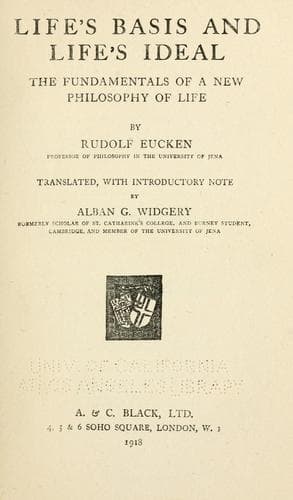
Life's Basis and Life's Ideal: The Fundamentals of a New Philosophy of LifeEucken, Rudolf
Philosophy
Life's Basis and Life's Ideal: The Fundamentals of a New Philosophy of Life
Eucken, Rudolf
Life; Ontology
Such an organisation gives to life a movement in two directions: it must
be conducted from whole to part, and from part to whole. The individual
departments must be developed far enough to reveal their particularity
and to produce a characteristic tendency of their own; but they must
remain within a whole, to receive from it and to lead back to it. The
relations between the individual departments will be distinctive in such
a system; the influence of one upon another will be without suspicion,
and advantageous, only when it is exerted through the mediation of the
whole; while disturbances are inevitable, when one conveys immediate
experiences to another and imposes its nature upon another. It was
necessary, for example, to reject the earlier encroachments of religion
upon other departments of life; art, too, often found it necessary to
resist the tendency to subordinate it to morality; and to-day there is a
strong inclination to shape every department of life in accordance with
the instructions of natural science. Yet although such encroachments
must be rejected, and the independence of each in relation to the others
preserved, the changes that are effected in one department are by no
means indifferent and lost to the other departments. For, if through
these changes life as a whole is developed, then the effect of the
change must extend to the other departments. In this manner of mediation
religion has exercised a strong influence upon the other departments of
life; and in this sense, to-day, an influence of natural science upon
the whole circle of existence will be readily acknowledged. But this
does not involve a limitation or an enslaving of other departments,
because the change in life as a whole must now be ascertained first;
and, besides, each individual department must test by its own
experiences the suggestion coming from the whole.
When we take all these facts into consideration we see that the
organisation of culture is a difficult problem and that our organisation
is unstable. In culture, different tendencies will cross one another;
antitheses cannot be avoided, and collisions will not be lacking. But
that which life loses in completeness and exclusiveness, it gains in
wealth and movement; and division need not be a cause of anxiety so long
as a powerful spiritual life embraces and unifies the multiplicity.
Without such a counteraction by the spiritual life we must drift
towards ever greater specialisation; and, with this, we should not only
see life become more and more disintegrated, but we should also become
less and less spiritual, and be transformed into a soulless mechanism.
II. THE FORM OF THE INDIVIDUAL DEPARTMENTS
_Preliminary Considerations_
Public-domain text, read in full here on John Shaqi.
Reviews
Reviews
No reviews yet
Be the first to share your thoughts on this work.
Elsewhere in the archive
Join the Discussion
Join the discussion
Sign in to leave a comment or review.
Sign InorCreate an account