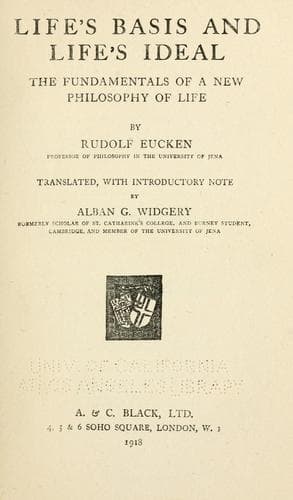
Life's Basis and Life's Ideal: The Fundamentals of a New Philosophy of LifeEucken, Rudolf
Philosophy
Life's Basis and Life's Ideal: The Fundamentals of a New Philosophy of Life
Eucken, Rudolf
Life; Ontology
Before we proceed to discuss the individual departments of life we may
briefly consider the common task that is imposed upon them all by the
distinctive condition of the time: they must become independent in
relation to the earlier as well as to the more modern conceptions of
them, and, if necessary, take up a conflict against both. The course of
our investigation can have left no doubt with regard to the state of
prostration of the older forms of life: the uncertainty affects the
whole and the fundamental principles much more than it has ever done
before. Formerly the struggle was concerned rather with individual
departments or individual tendencies of life; it was carried on more in
reference to the conception and meaning of fundamental truths than with
regard to the validity of those truths themselves. The passionate
struggles of the period of the Reformation left the fundamentals of
Christianity untouched; in a similar manner the later attacks upon
ecclesiastical religion usually had a basis of firm faith in morality,
and derived their power more especially from it. To-day the authority of
morality is just as seriously shaken as that of religion; and the
conception of truth is itself in the same condition of uncertainty.
In this condition of things an appeal to history cannot be employed as
proof of any position; a patchwork of our own and of something alien
gives us still less a position above perplexity: there is no other way
than to take up the problem with the means of the present itself. For
this the acknowledgment of the independence of the spiritual life forms
a fit foundation. The spiritual life is not dependent upon and fixed to
particular temporal conditions; ever anew it can break forth
spontaneously, and from the particularity of the time advance to eternal
truths. It is to us a source of joy that a time has come again when we
need not follow other paths, but must go our own; when nothing can bind
us but that which has been approved by our own being and our own
conviction. It is not necessary for a time such as this to take up an
attitude of hostility towards the whole past; rather--and especially
when it thinks worthily of itself--it will seek a friendly relationship
with history. But this is possible only when the present has attained
complete independence, and only from this independent position; only
when an eternal content is revealed in that which history conveys to us.
In opposition to submission to authority such a time makes a demand for
unlimited freedom and complete spontaneity; such freedom and spontaneity
are essential if life is again to find the truthfulness and the inner
power that we so painfully miss.
Public-domain text, read in full here on John Shaqi.
Reviews
Reviews
No reviews yet
Be the first to share your thoughts on this work.
Elsewhere in the archive
Join the Discussion
Join the discussion
Sign in to leave a comment or review.
Sign InorCreate an account